


What "5kW" really means
"5kW" is used for two different things, and mixing them up is the most common reason buyers end up with a system that makes less power than they expected. A 5 kW array means 5,000 watts of solar panels on the roof or a ground mount - that number decides how much energy you collect per day. A 5,000W inverter means the box that turns battery and solar power into 120V or 240V AC can supply 5,000 watts at once - that number decides how many appliances can run at the same moment.
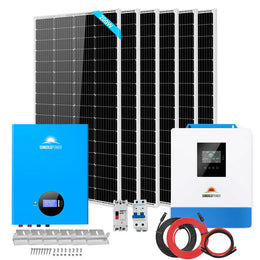
Many packages sold as "5kW solar kits" are named after the inverter. The Sungold kits in our 5kW solar system collection all use a 5,000W inverter, but ship with 1.2 kW to 2.7 kW of panels. That is not a flaw - their inverters accept up to 5,000-5,500 W of solar, so you can add panels later - but it changes the daily output a lot. In this guide, "5kW system" means a 5 kW array unless we say otherwise, and every build lists both numbers.
| Term | What it measures | Why it matters | Typical value in a "5kW" system |
|---|---|---|---|
| Array size (kW DC) | Total panel watts | Sets daily energy (kWh) | 1.2-5.3 kW in the kits below |
| Inverter output (kW AC) | Power you can draw at once | Sets how many loads run together | 4-8 kW |
| Battery capacity (kWh) | Energy stored for night and outages | Sets how long you run without sun | 5.12-16 kWh |
| Battery discharge (A or kW) | How fast the battery can deliver | Must match the inverter at full load | 100-200 A at 48V |

How much a 5kW system produces
We use the same rule of thumb as our other sizing guides: daily kWh = array kW x peak sun hours x 0.77. The 0.77 factor covers heat, wiring, inverter and battery losses and a little dirt on the glass. Peak sun hours are the hours of full-strength sun your location averages per day - about 3.5 in the Pacific Northwest and the Great Lakes in winter, 4.5 across much of the US on an annual average, and 5.5-6.5 in the Southwest.
| Peak sun hours | Example locations | 5 kW per day | 5 kW per month | 5 kW per year |
|---|---|---|---|---|
| 3.5 | Seattle, Buffalo, Vancouver BC (annual) | 13.5 kWh | ~404 kWh | ~4,920 kWh |
| 4.5 | Kansas City, Atlanta, Denver (winter) | 17.3 kWh | ~520 kWh | ~6,320 kWh |
| 5.5 | Dallas, Southern California coast | 21.2 kWh | ~635 kWh | ~7,730 kWh |
| 6.5 | Phoenix, Las Vegas, Albuquerque | 25.0 kWh | ~751 kWh | ~9,130 kWh |
For a precise number, run your address through NREL's PVWatts calculator with your roof tilt and direction. PVWatts usually lands within about 10% of the simple formula for a south-facing roof.
The chart below shows why the array size matters more than the "5kW" in a product title. It compares what each build in this guide collects on a 4.5-sun-hour day with an example home that uses 11.6 kWh of essentials a day (the load list is in the next section).
How many panels a 5kW system needs
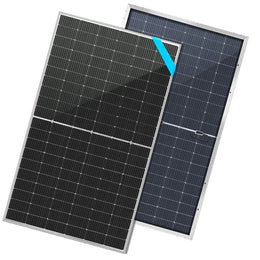
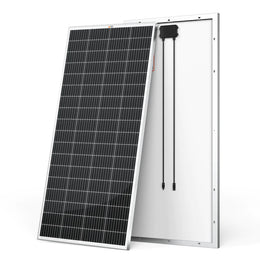
Divide 5,000 W by the panel wattage and round up. Modern residential panels are 400-450 W, so a 5 kW array is 11-13 panels. Roof area is the next check: a 440 W panel is 67.8 x 44.65 in (about 21 sq ft), so 12 of them cover roughly 252 sq ft of panel surface, plus spacing and fire-code setbacks. Weight is about 46 lb per 440 W panel, or roughly 3 lb per sq ft once racking is added.
| Panel size | Panels for ~5 kW | Array (kW) | Panel area | Notes |
|---|---|---|---|---|
| 200 W | 25 | 5.0 | ~350 sq ft | Too many panels and connections for a house roof |
| 370 W | 14 | 5.18 | ~280 sq ft | Older 60/66-cell size |
| 415 W | 12 | 4.98 | ~255 sq ft | Same panel as the SGR-5KE kit |
| 440 W N-type | 12 | 5.28 | ~252 sq ft | Our pick: UL 61730, 12 for $2,519 |
| 450 W | 11 | 4.95 | ~255 sq ft | Same panel as the SGK-5PRO kit |
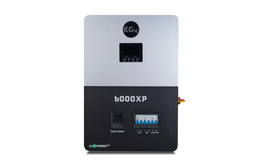
String check. The 440 W panel has a 33.48 V working voltage and a 39.03 V open-circuit voltage (Voc). Multiply Voc by 1.14 for cold mornings (NEC 690.7 style correction): 44.5 V per panel. Two strings of 6 give about 201 V working and 267 V cold - inside the MPPT window of the EG4 12kPV (120-500 V) and the 6000XP (480 V max). One string of 10 (about 335 V working, 445 V cold, 13.2 A) fits the 500 V, 22 A input of the Sungold SPH5048P inverter used in the SGM-5K5E and SGK-5PRO kits. A string of 12 would hit about 534 V cold and is too high for those 500 V inputs. These are our calculations from the listed panel data - your installer confirms the final layout against your coldest local temperature.
What a 5kW system with battery can run
Two questions decide this: can the system supply enough energy per day (array and battery), and can it deliver enough power at once (inverter and battery current)? Here is a realistic essentials list for a small home, cabin or backup-ready house:
| Load | Running watts | Hours or use per day | kWh per day |
|---|---|---|---|
| Refrigerator (Energy Star) | 150 W | ~1/3 duty cycle | 1.5 |
| Chest freezer | 100 W | ~1/3 duty cycle | 0.9 |
| LED lighting (15 bulbs) | 150 W | 4 h | 0.6 |
| Internet, TV, laptops, phones | 250 W | 5 h | 1.2 |
| Well pump, 1 HP (120V) | 1,000 W (3,000 W start) | 1.2 h | 1.2 |
| Furnace blower or fans | 350 W | 4 h | 1.4 |
| Washer (3 loads a week, averaged) | 500 W | 0.8 h | 0.4 |
| Microwave and coffee maker | 1,200 W | 40 min | 0.8 |
| Mini-split, 12,000 BTU | 600 W average | 6 h | 3.6 |
| Total | 11.6 kWh |
Energy: at 4.5 sun hours a true 5 kW array makes 17.3 kWh, so it covers this 11.6 kWh day with about 5.7 kWh to spare for recharging the battery after a cloudy day. A 2.5 kW kit makes about 8.6 kWh and runs short unless you trim the mini-split or add panels. For comparison, the average US home uses roughly 29 kWh a day, so a 5 kW array covers around 60% of a typical home and close to 100% of an efficient one.
Power: if the fridge, freezer, pump, microwave, mini-split and electronics all run together, the peak is about 3,750 W, plus a short 3,000 W start-up spike from the pump. A 5,000W inverter with a 10,000 VA peak handles that. What it does not handle is 240V equipment on a 120V-only inverter: central air, an electric range, a dryer, an EV charger at Level 2 or a 240V well pump need a split-phase inverter (the EG4 12kPV and 6000XP are 120/240V) or two 120V inverters run in parallel. Our inverter sizing guide walks through surge and 240V sizing in detail.
How much battery a 5kW system needs
The quick method: battery kWh = kWh you use after sunset x days of backup ÷ 0.9. In the example home, about half of the 11.6 kWh is used in the evening and overnight, so one night needs 5.8 ÷ 0.9 = 6.4 kWh. A 10.24 kWh bank covers that with a margin for a slow morning; 15-20 kWh covers two days of bad weather or a longer outage. Our battery sizing guide has the full method by home and outage length.
The second check is current. A 5,000 W inverter on a 48V battery pulls about 5,000 ÷ 48 ÷ 0.92 = 113 A at full load. A single 5.12 kWh 48V battery is usually rated 100 A continuous, so one battery is at its limit if you ever run the inverter flat out. Two batteries in parallel share the load (50-60 A each), which also helps cycle life. That is why most of the builds below use two 5.12 kWh modules or one large 200 A wall battery. More 48V options are in our lithium battery collection.
| Goal | Battery size | Batteries (5.12 kWh, 48V) | Fits |
|---|---|---|---|
| Fridge, lights, internet overnight | 5 kWh | 1 | Cabins, light backup |
| Essentials for one night (example home) | 10 kWh | 2 | Most 5 kW homes |
| Essentials for two cloudy days | 15-20 kWh | 3-4 | Off-grid homes, long outages |
| Run the inverter at 5,000 W for an hour | 5 kWh + 113 A | 2 (for current) | Shops, pumps, mini-splits |
5kW solar system price: kits, builds and installed
There are three ways to buy a 5 kW system, and the prices are very different:
- All-in-one off-grid kit (inverter, battery, some panels, cables and brackets in one box): $3,045-$4,858 in our stock after code ECO100, but with 1.2-2.7 kW of panels.
- Component build (hybrid inverter + 12 panels + batteries you choose): about $7,768-$7,934 for a true 5.28 kW array with 10-16 kWh of storage.
- Installed by a solar company: commonly $2.50-$3.50 per watt before incentives, so $12,500-$17,500 for 5 kW without a battery. A 13.5 kWh installed battery adds roughly $12,000-$16,000 (our whole-home backup cost guide uses $14,750 as a midpoint).
Equipment prices do not include racking for every roof type, conduit, breakers, permits, inspection or an electrician's time. Budget 15-30% on top for a DIY-assisted install where a licensed electrician makes the final connections. The federal 25D residential credit ended for expenditures after December 31, 2025, so for 2026 purchases the savings come from state, city and utility programs - see our solar rebates by state guide.
7 in-stock 5kW builds compared
| Build | Price | Solar | Battery | Inverter | Grid export | kWh/day at 4.5 h |
|---|---|---|---|---|---|---|
| EG4 12kPV + 12 x 440W + 2 x CoreX 5 Elite | $7,768 | 5.28 kW | 10.24 kWh | 8 kW, 120/240V | Yes (hybrid) | 18.3 |
| EG4 6000XP + WallMount 314Ah AW + 12 x 440W | $7,933.97 | 5.28 kW | 16 kWh (12.86 usable) | 6 kW, 120/240V | No (off-grid) | 18.3 |
| Sungold SGR-5KE | $4,782 ($4,682 ECO100) | 2.49 kW | 10.24 kWh | 5 kW, 120V | No | 8.6 |
| Sungold SGK-5PRO | $4,958 ($4,858 ECO100) | 2.7 kW | 10.24 kWh, self-heating | 5 kW, 120V | No | 9.4 |
| Sungold SGM-5K5E | $3,145 ($3,045 ECO100) | 1.2 kW | 5.12 kWh | 5 kW, 120V | No | 4.2 |
| Mango Power S Pro 5,000W set + 10 x 440W | $4,732 | 4.4 kW | None | 5 kW, 240V micro | Grid-tie (zero-export gateway) | 15.2 |
| HUSKY 2 10.24 kWh + Victron MultiPlus-II 5000 | $4,926.80 | Add MPPT | 10.24 kWh | 4 kW (5,000 VA), 120V | No | - |
All seven are in stock as of November 10, 2026. Code ECO100 ($100 off orders of $1,500 or more) applies to the three Sungold kits; the EG4, Mango, HUSKY and panel items are not in a promo-code collection today, so their prices are shown as listed.
EG4 12kPV + 12 x Sungold 440W + 2 x Sungold CoreX 5 Elite - $7,768

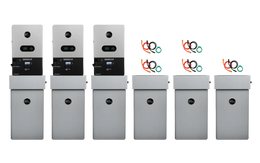
This is the build we would quote a grid-connected homeowner who wants a real 5 kW array and outage backup. The EG4 12kPV ($2,999) is a 120/240V split-phase hybrid inverter rated 8,000 W continuous and 16,000 W for half a second, with two MPPT trackers that use up to 12,000 W of solar. The Sungold 440W N-type panels (12 for $2,519) go in two strings of six, one per tracker, at about 201 V working - which leaves room to double the array later without a new inverter. Two Sungold CoreX 5 Elite wall batteries ($1,125 each) add 10.24 kWh; each has a 100 A BMS, so together they cover the inverter's 167 A battery limit at the power this array produces, and the listing names EG4 among its closed-loop (CAN/RS485) partners. The 12kPV is NEMA 4X for outdoor mounting, UL 9540 certified and carries a 10-year warranty; the CoreX is IP20, so it goes in a garage or utility room. Total: $2,999 + $2,519 + $2,250 = $7,768, or about $1.47 per watt of solar with the battery included.
- True 5.28 kW array: ~18 kWh a day at 4.5 sun hours
- 120/240V output runs 240V loads
- Grid-tie capable and room to grow to 12 kW of solar
- 10-year inverter and battery warranties
- Component build - you plan racking, breakers and conduit
- CoreX batteries are indoor only (IP20)
- No promo code applies to these items today
EG4 6000XP + WallMount 314Ah All-Weather bundle + 12 x 440W - $7,933.97

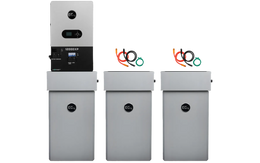
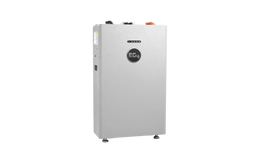
The EG4 6000XP + WallMount bundle ($5,414.97) pairs a 6,000 W split-phase off-grid inverter with a 16 kWh (12.86 kWh recommended usable) 48V wall battery. Add 12 x 440W panels ($2,519) in two strings of six - about 2,640 W per tracker against the inverter's 8,000 W of dual-MPPT input - and you have a 5.28 kW array with the largest battery in this list. The battery is IP67 with self-heating, delivers up to 200 A (10.2 kW) continuous and is rated 10,000 cycles at 80% depth of discharge with a 10-year or 10,000-cycle warranty; the listing shows UL1973 and UL9540A, with UL9540 depending on configuration. The 6000XP switches to battery in under 15 ms. It is an off-grid inverter: it can use the grid or a generator as a charging and pass-through source, but it does not export power for net metering, and it is IP20, so it needs an indoor or enclosed spot.
- 16 kWh battery - most storage in this guide
- 120/240V split-phase output
- All-weather, self-heating battery
- One battery covers full inverter current (200 A)
- No grid export or net metering
- Inverter must be indoors (IP20)
- Heaviest and priciest build here
Sungold Power SGR-5KE - $4,782 ($4,682 with ECO100)

The SGR-5KE is the simplest way to get a 5,000W inverter, 10 kWh of storage and a usable amount of solar in one order. It includes a 5,000 W / 10,000 VA peak 120V inverter-charger with built-in Wi-Fi and an MPPT controller (5,000 W, 500 V max, 120-450 V window, up to 80 A charge), two 5.12 kWh SG48100P rack batteries (100 A max each, 7,000 cycles at 80% depth of discharge), six 415 W panels (2.49 kW), 50 ft of PV extension cable and Z-brackets. The inverter is ETL listed to UL1741. With 2.49 kW of panels it makes about 8.6 kWh on a 4.5-hour day by our formula - the listing's "around 10 kWh from 4 hours" is optimistic - so plan to add panels if you want to cover a full day. The SGM-5K10M ($4,807) is a near twin with six 370 W panels (2.22 kW) and wall-mount batteries.
- Everything in one box, including brackets
- Two batteries share the 5 kW load
- UL1741 (ETL) inverter
- Room to grow to 5,000 W of solar
- 120V only - no 240V loads without a second unit
- Battery boxes are IP20 (indoor)
- 2.49 kW of panels is half a true 5 kW array
Sungold Power SGK-5PRO - $4,958 ($4,858 with ECO100)

The SGK-5PRO uses four 12V 200Ah LiFePO4 batteries wired in series to 48V (10.24 kWh). Each is IP65, has Bluetooth monitoring and self-heats below 33.8°F, so it charges in an unheated shed or cabin where many rack batteries would refuse. The kit adds six 450 W UL 61730 panels (2.7 kW - the most solar of the all-in-one kits), a 5,000 W / 10,000 VA 120V inverter with Wi-Fi and a 5,500 W MPPT input (500 V, 22 A), a 200 A DC breaker, a 25 A PV breaker, 4 AWG cable and Z-brackets. The inverter lists CE, FCC and UL1741. Panels carry a 12-year material warranty and 80% output at 25 years.
- Self-heating, IP65 batteries
- Most panels of the all-in-one kits (2.7 kW)
- Breakers and battery cable included
- UL 61730 panels
- 120V only
- Four series batteries to wire and balance
- Still about half of a true 5 kW array
Sungold Power SGM-5K5E - $3,145 ($3,045 with ECO100)

The SGM-5K5E is the lowest-cost way into a 5,000W system: the same SPH5048P inverter (5,000 W, 10,000 VA peak, 100 A charging, 5,500 W PV input, parallel up to 6 units) with one 5.12 kWh SG48100M wall battery (7,000 cycles at 80% depth of discharge, IP65 box) and six 200 W panels (1.2 kW). Out of the box it makes about 4.2 kWh a day at 4.5 sun hours - fine for a weekend cabin with a fridge, lights and a small pump. Its real value is the upgrade path: the inverter accepts a single string of up to 10 x 440 W panels (4.4 kW, about 445 V cold by our calculation), and a second battery can be added for longer nights and to share the current at full load. The listing does not state warranty terms for the inverter and panels, so ask us before you order if that matters for your project.
- Lowest entry price for a 5,000W inverter
- Inverter takes up to 5.5 kW of solar later
- IP65 wall battery
- Parallel up to 6 inverters (120/240V possible)
- Only 1.2 kW of panels and 5.12 kWh included
- One battery is at its 100 A limit at full load
- Inverter and panel warranty not stated on the listing
Mango Power S Pro 5,000W microinverter set + 10 x 440W - $4,732

If you are on the grid and want the lowest cost per kWh now, with a battery later, the Mango Power S Pro 5,000W set ($2,608, list $3,108) is ten 500 W 240V microinverters, a 10-in-1 trunk cable and a Smart Gateway Lite meter. Each panel gets its own MPPT (16-60 V input), so shade on one panel does not drag down the others. The units are NEMA 6P / IP68, UL 1741-SA/SB, IEEE 1547 and CA Rule 21 listed, 97% CEC efficient, with a 25-year warranty. With 10 x 440W panels ($2,124) you get a 4.4 kW array (15.2 kWh a day at 4.5 sun hours) for $4,732. Mango recommends a 1.2-1.5 DC/AC ratio, so larger panels per microinverter make fuller use of each 500 W unit. The gateway enforces zero export where your utility requires it. The catch: like any grid-tie system, it shuts off in a blackout unless paired with a UL-certified home battery.
- Lowest price per watt of solar here
- Panel-level MPPT handles shade
- 25-year microinverter warranty
- 5 kW at 240V needs only a ~30 A breaker
- No power during outages
- No battery included
- Needs utility interconnection approval
HUSKY 2 10.24 kWh + Victron MultiPlus-II 5000 - $4,926.80

The HUSKY 2 + Victron kit (list $5,349) is the premium choice for backup and mobile setups: two 5.12 kWh HUSKY 2 batteries (IP65 / NEMA 4X, self-heating, 100 A continuous and 150 A peak each), a Victron MultiPlus-II 48/5000 inverter-charger and a Cerbo GX for remote monitoring in the VRM app. Note the rating: 5,000 VA is about 4,000 W continuous at 77°F, with 9,000 W peak. PowerAssist lets the batteries top up a weak generator or shore connection instead of tripping its breaker, and the transfer is under 20 ms. The MultiPlus-II has no built-in solar charger, so you add a separate MPPT controller and panels to make it a solar system - ask us for a matched quote.
- PowerAssist boosts small generators
- Victron monitoring and support network
- Outdoor-rated, self-heating batteries
- Under 20 ms transfer
- No solar controller included
- 4,000 W continuous, not 5,000 W
- 120V output on a single unit
Grid-tie, off-grid or hybrid: which 5kW build fits
| Your situation | Build type | Best fit above | Why |
|---|---|---|---|
| On the grid, want lower bills and outage backup | Hybrid | EG4 12kPV build | Exports when allowed, runs from battery in a blackout |
| On the grid, bills only, battery later | Grid-tie micro | Mango S Pro + panels | Lowest cost per kWh; add a battery later |
| Off-grid home or cabin with 240V loads | Off-grid split-phase | EG4 6000XP + WallMount | 16 kWh storage, 120/240V |
| Off-grid cabin, 120V loads, simple install | All-in-one kit | SGR-5KE or SGK-5PRO | One box, 10 kWh, add panels later |
| Weekend cabin on a budget | All-in-one starter | SGM-5K5E | $3,045 now, grows to 5.5 kW of solar |
| Backup with a generator or shore power | Inverter-charger + battery | HUSKY 2 + Victron | PowerAssist, add MPPT for solar |
Grid-tied and hybrid systems need a permit and utility interconnection approval before they switch on, and the interconnection point has to respect the panel's busbar rating. Under the common 120% rule, a 200 A panel with a 200 A main breaker allows a 40 A backfed solar breaker: a 5 kW, 240V microinverter array (20.8 A x 1.25 = 26 A, so a 30 A breaker) fits, while an 8 kW hybrid inverter like the 12kPV (33.3 A x 1.25 = 41.6 A) may need a line-side tap or a main-breaker derate. Off-grid inverters never export, so they avoid interconnection but still need a permit in most places. If you are unsure which type you need, our hybrid vs off-grid vs grid-tie guide explains the differences, and our hybrid inverter collection lists the in-stock split-phase models. Bigger homes should compare the 8kW price guide and what size solar system you need.
What buyers ask before buying a 5kW system
These questions come from what people search before buying a 5 kW system (Google Search Console data for our site and Google's question results), answered with the products in this guide.
How much is a 5kW solar system with battery?
From our stock on November 10, 2026: $3,045 for a 5,000W kit with 5.12 kWh and 1.2 kW of panels (with ECO100), $4,682-$4,858 for 10.24 kWh kits with 2.5-2.7 kW of panels, and $7,768-$7,934 for a true 5.28 kW array with 10-16 kWh of battery. Installed systems usually cost two to three times as much.
How many solar panels do I need for a 5kW system?
12 x 440 W (5.28 kW), 12 x 415 W (4.98 kW) or 11 x 450 W (4.95 kW). With older 370 W panels you need 14.
What can a 5kW solar system power?
A fridge, freezer, lights, electronics, a 1 HP pump, a microwave and a 12,000 BTU mini-split all at once, about 3,750 W, and about 17 kWh of energy a day at 4.5 sun hours. Central air, electric heat and a 240V range need more solar and a split-phase inverter.
Is a "5000 watt inverter with battery kit" a 5kW solar system?
Not necessarily. It has a 5 kW inverter, but check the panel watts: the Sungold 5,000W kits ship with 1.2-2.7 kW of panels. You can add panels up to the inverter's 5,000-5,500 W solar limit.
What is the difference between a 5kW system and a 5kWh battery?
kW is power (a rate), kWh is energy (an amount). A 5 kW array makes about 17 kWh on an average day; a 5.12 kWh battery stores about one evening of essentials. Many homes pair a 5 kW array with 10 kWh of battery.
5kW solar system FAQ
How many solar panels are in a 5kW system?
It depends on panel wattage: 12 x 440 W panels make 5.28 kW, 13 x 400 W make 5.2 kW and 11 x 450 W make 4.95 kW. With today's 400-450 W panels, plan on 11-13 panels and roughly 260-300 sq ft of roof.
How much electricity does a 5kW solar system produce per day?
About 13.5 kWh at 3.5 peak sun hours, 17.3 kWh at 4.5 hours, 21.2 kWh at 5.5 hours and 25 kWh at 6.5 hours (kW x sun hours x 0.77 for real-world losses). At 4.5 sun hours that is roughly 520 kWh a month.
How much does a 5kW solar system with battery cost?
Equipment for a true 5 kW array with about 10-16 kWh of battery costs about $7,800-$7,950 from our current stock (prices checked November 10, 2026). All-in-one 5,000W kits with 1.2-2.7 kW of panels start at $3,045 with code ECO100. A professionally installed 5 kW system is commonly $12,500-$17,500 before any battery.
Can a 5kW solar system run a house?
It can cover most of a small or efficient home: 17 kWh a day at 4.5 sun hours is about 60% of the average US home's use. It runs a fridge, freezer, lights, electronics, a well pump and a mini-split, but not central air or electric heat on its own.
How many batteries do I need for a 5kW solar system?
For overnight essentials, 10 kWh is the common starting point - two 5.12 kWh 48V batteries. Two batteries also share the current a 5,000W inverter pulls at full load (about 110 A at 48V). For two cloudy days or larger loads, plan 15-20 kWh.
Will a 5kW solar system work in a power outage?
Only if it has a battery and a hybrid or off-grid inverter. A plain grid-tie system, including microinverters, shuts off when the grid goes down. The hybrid and off-grid builds in this guide keep running from the battery and recharge from the panels.
Is a 5,000W inverter the same as a 5kW solar system?
No. The inverter rating is how much AC power you can draw at once; the array size is how much solar you collect. Many 5,000W kits ship with only 1.2-2.7 kW of panels, so they produce a quarter to half of what a true 5 kW array makes.

Serhii Dovzhenko, Solar & Energy Storage Specialist at Eco Solar Kits · LinkedIn
Serhii is based in Vancouver, BC, and works on product data, system sizing and buyer guides for Eco Solar Kits. He attends solar and energy storage industry conferences and is involved in the community of electricians in Vancouver, BC. Credit for the data verification in this guide goes to Adsec.ca.