


The three numbers that size an inverter
An inverter turns battery or solar DC power into the AC power your outlets use. Pick one too small and it shuts down every time the well pump kicks on. Pick one far too big and you pay for capacity you never use, plus a higher idle draw that quietly drains the battery overnight. Getting the size right comes down to three numbers:
- Continuous watts - the load the inverter can carry for hours. It must cover everything that runs at the same time, with a margin.
- Surge (peak) watts - the short burst it can deliver for a fraction of a second to a few seconds. Motors, compressors and pumps need two to five times their running watts to start.
- Output voltage - 120V only, or 120/240V split phase. A single 240V well pump, dryer, range, EV charger or central heat pump settles this on its own.
Two more checks follow from those: the battery has to deliver the DC current the inverter pulls, and the solar array has to fit the inverter's voltage window. We cover both below. If you are not sure which type of inverter you need - grid-tie, off-grid or hybrid - read our hybrid vs off-grid vs grid-tie inverter guide first; this one is about size.
Step 1: Add up your running watts
List the loads you want the inverter to carry and write down the running watts of each. The data plate on the appliance gives watts, or volts x amps. Then mark which ones actually run together. A microwave, a hair dryer and a coffee maker rarely all run at once; a fridge, a freezer, a furnace blower and the lights often do.
| Appliance | Running watts (typical) | Start-up watts (typical) | Voltage |
|---|---|---|---|
| LED lights, router, TV, laptops | 150-400 W | same | 120V |
| Refrigerator (modern) | 100-200 W | 800-1,200 W | 120V |
| Chest freezer | 80-150 W | 600-900 W | 120V |
| Furnace blower (1/2 HP) | 500-800 W | 1,200-1,800 W | 120V |
| Microwave | 1,000-1,500 W | same | 120V |
| Washing machine | 400-800 W | 1,000-1,500 W | 120V |
| Window AC (10,000 BTU) | 900-1,200 W | 2,000-3,000 W | 120V |
| Mini-split heat pump (12,000 BTU) | 900-1,300 W | little extra (inverter-driven) | 120V or 240V |
| Well pump (1 HP) | 900-1,200 W | 3,000-4,000 W | usually 240V |
| Central AC / heat pump (3 ton) | 3,000-3,800 W | 6,000-10,000 W (less with a soft starter) | 240V |
| Electric dryer | 4,500-5,500 W | same | 240V |
| Electric range (2 burners + oven) | 3,000-7,000 W | same | 240V |
| Level 2 EV charger (32 A) | 7,700 W | same | 240V |
Add the running watts of the loads that overlap, then multiply by 1.25. That 25% margin keeps the inverter out of its overload zone, covers loads you forgot, and matters because most inverters lose some output in a hot garage or utility room (several units here derate above 113°F). The result is your minimum continuous rating.
Step 2: Check surge for motors and compressors
Motors draw a big inrush current for a moment while they get spinning. A refrigerator that runs at 150 W can pull over 1,000 W for a second; a 1 HP well pump that runs at about 1,000 W can pull 3,000-4,000 W. If the inverter's surge rating is too low, the motor stalls, the inverter trips on overload, and you hear a click and silence.
The test: take your continuous load with everything else running, then add the extra start-up watts of the single biggest motor (start watts minus running watts). Two motors rarely start in the same half second, so you only stack the largest one. That total must sit below the inverter's surge rating, and you should read how long the surge lasts - spec sheets range from half a second to five seconds.
Examples from the inverters in this guide: the EG4 FlexBOSS18 lists 20,000 W for 0.5 s and 15,000 W for 1 s; the Sungold FR12K-B lists 24,000 W peak and a 6 HP motor rating; the APEX-10K lists 20,000 VA and 6 HP, the APEX-6.5K 13,000 VA and 4 HP; the Rich Solar NOVA MAX 3K lists 6,000 W for 5 seconds. A horsepower rating is the most practical number when you are sizing for a pump, because it already accounts for inrush.
Two ways to shrink the surge you have to buy: a soft starter on a central AC compressor (often cuts start current by half or more), and inverter-driven mini-splits and variable-speed pumps, which ramp up instead of slamming on.
Step 3: Decide between 120V and 120/240V split phase
US homes get split-phase power: two 120V legs that make 240V between them. Lights and outlets use 120V; well pumps, dryers, ranges, water heaters, central heat pumps and EV chargers use 240V. A 120V-only inverter cannot run those 240V loads at all, no matter how many watts it has.
- 120V only is fine for vans, RVs, boats, sheds and most cabins. Every 12V and 24V inverter in this guide is 120V only.
- 120/240V split phase is the default for a house or a homestead with a well. All the 48V inverters in this guide are split phase.
- Balance the legs. A split-phase inverter usually has a per-leg limit, roughly half its rating. Put heavy 120V loads on opposite legs so one side does not overload while the other idles.
- 120/208V is common in commercial buildings and some apartments; the FlexBOSS18 and Sol-Ark 15K list it, the off-grid units here do not. Three-phase sites need paralleled units or a three-phase model; our inverter collection has both.
Inverter size by home and use
If you want a starting point before you do the math, this is what we see most often. Treat it as a range, not a rule: a small all-electric house can need more than a large house with gas appliances.
| Use | Typical loads | Inverter size | Voltage | Battery voltage |
|---|---|---|---|---|
| Van, camper, boat | Fridge, lights, fan, laptop, small microwave | 1,000-2,000 W | 120V | 12V |
| Large RV or cabin | Above + 13,500 BTU rooftop AC (with soft start) or tools | 3,000 W | 120V | 24V |
| Efficient off-grid home | Fridge, freezer, 240V well pump, furnace blower, washer, lights | 6,000-8,000 W | 120/240V | 48V |
| Off-grid home, more electric | Above + electric range or dryer, mini-splits | 10,000-12,000 W | 120/240V | 48V |
| Whole-home backup, grid-tied | Most of the panel, central AC with soft starter | 12,000-15,000 W | 120/240V | 48V |
| Large home, heat pump + EV | Everything, EV charging on a schedule | 15,000 W+ or two paralleled units | 120/240V | 48V |
The battery side: amps, voltage and discharge limits
An inverter pulls DC current from the battery: amps = watts / (battery volts x efficiency). The lower the battery voltage, the more current the same load needs - which is why big inverters run on 48V. We used about 90% efficiency below.
| AC load | 12V battery | 24V battery | 48V battery |
|---|---|---|---|
| 1,000 W | 93 A | 46 A | 23 A |
| 2,000 W | 185 A | 93 A | 46 A |
| 3,000 W | 278 A | 139 A | 69 A |
| 6,500 W | 602 A (not practical) | 301 A | 150 A |
| 10,000 W | 926 A (not practical) | 463 A (not practical) | 231 A |
| 13,000 W | - | - | 301 A |
Three practical rules come out of that table:
- Stay at 12V up to about 2,000-3,000 W, 24V up to about 3,000-4,000 W, and go 48V above that. Our 12V vs 24V vs 48V guide explains the cable and fuse math.
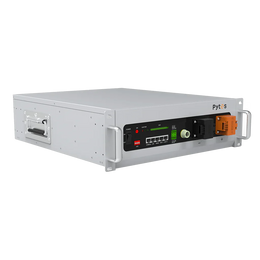
- The battery bank must be able to deliver that current. A 48V 100Ah server-rack battery with a 100 A BMS supports roughly 4.5-5 kW on its own; a 10 kW inverter at full load needs two or three of them in parallel, or one battery rated 200 A or more. A big inverter on a small battery trips the battery's BMS before the inverter ever reaches its rating.
- Read the inverter's own battery limit. Some hybrids can output more when the sun is shining than they can from the battery alone. The FlexBOSS18 lists 13,000 W continuous but a 10,000 W maximum battery charge/discharge, so at night on battery only, plan on about 10 kW. EG4 recommends more than 300Ah of battery per FlexBOSS18.
Also check idle draw. An inverter that is switched on but carrying nothing still burns power: the FlexBOSS18 lists under 65 W, which is about 1.5 kWh a day. Oversizing a cabin inverter to 10 kW "just in case" can cost more battery overnight than the cabin's actual loads.
The solar side: matching panels to the inverter
Most of the inverters here have built-in MPPT solar chargers, so the array has to fit three limits on the spec sheet:
- Maximum PV input (watts). Hybrids are usually built to take more solar than their AC output - the FlexBOSS18 takes up to 18,000 W of utilized PV against 13,000 W of AC output (a ratio near 1.4), the Sol-Ark 15K 18,000 W against 15,000 W. A modest oversize gives you more power in the morning, evening and winter.
- Maximum open-circuit voltage. Panel voltage rises in the cold. Multiply each panel's Voc by about 1.14 for very cold sites (NEC 690.7 gives the exact factor for your lowest temperature) and keep the string under the limit: 600 V for the FlexBOSS18 and Sol-Ark 15K, 550 V per channel for the APEX units, 500 V for the FR12K-B, 250 V for the NOVA MAX 3K. With a panel whose Voc is 39 V (44.5 V cold), that is 13 panels per string at 600 V, 12 at 550 V, 11 at 500 V and 5 at 250 V.
- MPPT operating window and current. The string's working voltage should sit inside the tracking range (120-440 V on the FlexBOSS18, 125-450 V on the APEX units, 125-425 V on the FR12K-B, 90-230 V on the NOVA MAX 3K), and the string current must not exceed the input current limit (for example 26 A per tracker on the FlexBOSS18, 22 A on the FR12K-B and APEX-10K).
A real-world mistake we see in our inbox: DC breakers and disconnects are rated by voltage too. Standard 48V DC breakers cannot safely interrupt a 100V+ solar string; the whole DC side has to be rated for the string voltage. When the paperwork gets this detailed, have a licensed electrician check it.
How much array you need in the first place is a separate question, covered in our solar system sizing guide.
Worked example: sizing an off-grid farmhouse
A two-bedroom off-grid farmhouse with a 240V well pump, propane range and dryer, and a mini-split for shoulder seasons. Here are the loads that can realistically run at the same time on a busy evening:
| Load | Running watts | Start-up watts |
|---|---|---|
| Refrigerator | 150 W | 1,200 W |
| Chest freezer | 100 W | 800 W |
| Well pump, 1 HP, 240V | 1,000 W | 3,500 W |
| Furnace blower | 600 W | 1,500 W |
| Lights, TV, router, chargers | 400 W | 400 W |
| Microwave | 1,200 W | 1,200 W |
| Washing machine | 500 W | 1,200 W |
| Mini-split, 12,000 BTU | 1,100 W | 1,100 W |
| Total running | 5,050 W |
- Continuous: 5,050 W x 1.25 = 6,313 W, so a 6,500 W inverter is the minimum.
- Surge: 5,050 W running + 2,500 W extra for the well pump start (3,500 - 1,000) = 7,550 W. The APEX-6.5K's 13,000 VA surge and 4 HP motor rating cover it with room to spare.
- Voltage: the 240V pump means split phase.
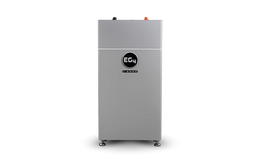
- Battery current: 6,500 W / (48 x 0.9) = about 150 A, so the battery bank needs at least 150 A of continuous discharge - two 100 A modules in parallel, or one larger wall battery.
Result: the APEX-6.5K fits. If the same house swaps the propane dryer for a 5,000 W electric one, the running total jumps past 10 kW and the right answer becomes a 10-12 kW unit like the APEX-10K or Sungold FR12K-B - or a rule that the dryer never runs with the microwave and well pump.
7 in-stock inverters from 2 kW to 15 kW
We picked one inverter for each common size, all in stock on November 9, 2026. Prices are list prices that day; codes are named only where the product is actually eligible.
| Inverter | Price | Continuous | Surge / motor | Output | Battery | Max solar | Grid export |
|---|---|---|---|---|---|---|---|
| EG4 FlexBOSS18 | $3,199.99 | 13,000 W (10,000 W from battery) | 20,000 W 0.5 s | 120/240V, 120/208V | 48V | 18,000 W | Yes (hybrid) |
| Sol-Ark 15K | $5,650 (ECO100: $5,550) | 15,000 W | not listed | 120/240V, 120/208V | 48V | 18,000 W | Yes (hybrid) |
| Sungold FR12K-B | $1,611 | 12,000 W | 24,000 W / 6 HP | 120/240V | 48V | 13,200 W | No (off-grid) |
| APEX-10K | $1,680 | 10,000 W | 20,000 VA / 6 HP | 120/240V | 48V | 10,500 W | No (off-grid) |
| APEX-6.5K | $1,490 | 6,500 W | 13,000 VA / 4 HP | 120/240V | 48V | 10,000 W | No (off-grid) |
| Rich Solar NOVA MAX 3K | $799 | 3,000 W | 6,000 W 5 s | 120V | 24V | 3,000 W | No |
| Rich Solar NOVA PURE 2K | $319 | 2,000 W | 4,000 W | 120V | 12V | none (inverter only) | No |
EG4 FlexBOSS18 - 13 kW split phase - $3,199.99

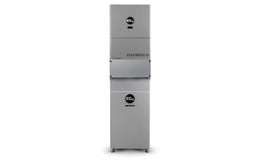
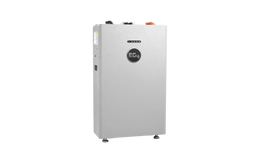
For most houses that want backup and solar on one box, 13 kW is the sweet spot: enough for a central AC with a soft starter plus the rest of the house, without paying for a 15-21 kW unit. The FlexBOSS18 delivers 13,000 W continuous at 120/240V or 120/208V, 20,000 W for half a second and 15,000 W for a second, and takes up to 18,000 W of solar on two MPPT trackers and four strings (100-600 V input, 120-440 V MPPT, 26 A per tracker). It works grid-tied (selling excess where your utility allows) or fully off-grid, has a 90 A grid feed-through, a NEMA 4X enclosure for outdoor walls, built-in Wi-Fi and 4G monitoring, and parallels up to 10 units. Certifications listed: UL 1741 and UL 9540 with BigBattery ETHOS and EG4 280Ah/314Ah batteries. Warranty: 10 years.
The size caveat: battery charge/discharge is listed at 10,000 W, so on battery alone at night plan on about 10 kW, and EG4 recommends more than 300Ah of 48V battery per inverter. Idle draw is under 65 W.
- 13 kW covers most homes in one unit
- 18 kW of solar input, four strings
- Outdoor-rated, UL 9540 with listed batteries
- Grid-tied or off-grid, 10-year warranty
- About 10 kW from battery alone
- 115 lb - two-person wall mount
- Needs a large battery bank (300Ah+)
Sol-Ark 15K - 15 kW split phase - $5,650

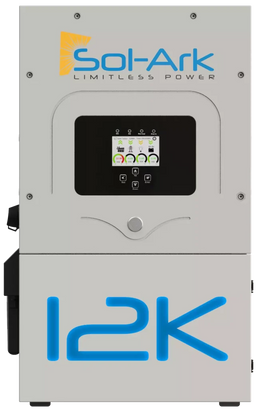
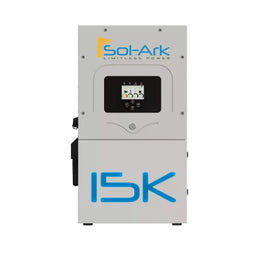
When the load list includes a heat pump, an electric range and an EV charger on a schedule, step up to 15 kW. The Sol-Ark 15K is rated 15,000 W at 120/240V or 120/208V, takes 18,000 W of solar up to 600 VDC, and charges a 48V battery at up to 250 A. It is a pre-wired all-in-one, which saves installer time, and supports grid-tied, zero-export, time-of-use, off-grid and AC-coupling modes. Listed certifications: UL 1741, UL 1741 SA and CSA C22.2 No. 107.1; 10-year warranty (extendable). It is in our ECO100 promotion: $100 off orders of $1,500 or more brings it to $5,550.
The listing does not give a surge figure or a battery-only output figure, so if your design depends on either, ask us for the current spec sheet before ordering. For a deeper brand comparison, see EG4 vs Sol-Ark.
- Full 15 kW for large panels
- Pre-wired, installer-friendly
- Many operating modes incl. zero export
- ECO100 eligible
- Highest price per kW here
- Surge rating not on the listing
- Overkill for an average home
Sungold FR12K-B - 12 kW off-grid - $1,611

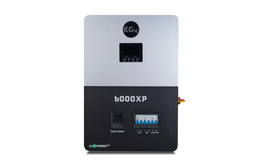
The lowest price per kW in this guide, for homes that will not sell power to the grid. The FR12K-B is a 12,000 W pure sine wave inverter-charger at 120V or 120/240V with 24,000 W peak and a 6 HP motor rating - plenty for a well pump plus an electric range. Two MPPT trackers take 6,600 W each (13,200 W total, 500 Vdc max, 125-425 Vdc window, 22 A each), the battery charger reaches 200 A, transfer time is 10 ms, and it has built-in PV rapid shutdown and breakers. Up to six units parallel to 72 kW. It uses grid or generator power as an input but does not export. Indoor only (IP20), 61.7 lb, UL 1741, 2-year warranty.
- $134 per kW of output
- 24 kW peak, 6 HP motors
- Built-in rapid shutdown and breakers
- Parallel to 72 kW
- No grid export
- Indoor installation only
- 2-year warranty
APEX-10K - 10 kW off-grid - $1,680

Answering the "10000 watt inverter 240v" search directly: the APEX-10K from BigBattery delivers 10,000 W continuous at 120/240V split phase, with 20,000 VA of surge and a 6 HP motor rating. Two MPPT trackers take 5,000 W + 5,500 W (550 Vdc per channel, 125-450 V window, 22 A each), solar and hybrid charging reach 200 A, and an 80 A pass-through carries critical loads from a grid or generator input (one AC source at a time). Up to six units can run in parallel, including three-phase with three or more. Operating range 14-131°F, derating above 113°F.
- True 10 kW at 240V
- 20,000 VA surge for pumps and compressors
- 200 A charging
- No grid export
- One AC input at a time (grid or generator)
APEX-6.5K - 6.5 kW off-grid - $1,490

The right size for the farmhouse in our worked example. The APEX-6.5K gives 6,500 W continuous at 120/240V, 13,000 VA surge and a 4 HP motor rating. Its standout feature is two separate AC inputs, so the grid and a generator can both stay wired in at the same time, with solar charging on top (5,000 W + 5,000 W, 550 Vdc per channel, 140 A solar charging). It weighs 48 lb, is IP20 (indoor or enclosed), parallels up to six units, lists UL 1741 among its certifications and carries a 5-year limited warranty.
- Grid and generator inputs at once
- Split phase in a compact 48 lb unit
- 10 kW of solar input
- 5-year warranty
- No grid export
- Too small for electric dryers or ranges plus other loads
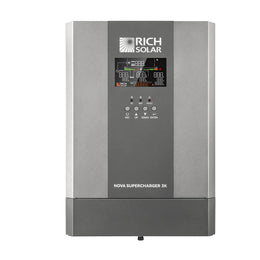
Rich Solar NOVA MAX 3K - 3 kW, 24V - $799

For a cabin, a large RV or a backup circuit in a small house, 3 kW at 120V is usually enough. The NOVA MAX 3K combines a 3,000 W pure sine wave inverter (6,000 W for 5 seconds), an 80 A MPPT charge controller (up to 3,000 W of solar, 90-230 VDC, 250 V max) and a utility/generator battery charger in one 26.5 lb box. Output is 120V only, efficiency 91%, and up to nine units can parallel. Rated operating range is 14-104°F, so keep it out of a hot, unvented compartment. It is in the ECO100 promotion, but alone it is under the $1,500 minimum.
- Inverter + MPPT + charger in one
- 6,000 W surge for 5 seconds
- Parallels for more power
- 120V only
- Max ambient 104°F
Rich Solar NOVA PURE 2K - 2 kW, 12V - $319

A plain inverter for a 12V system that already has its own charging. The NOVA PURE 2K delivers 2,000 W continuous and 4,000 W surge at 120V with under 3% THD, three outlets plus USB, a wired remote and ETL (UL 458) certification for RVs, vans and boats. At 10.1 lb it fits under a seat. It has no solar input or charger, so pair it with a charge controller or DC-DC charger; at full load it pulls about 185 A from a 12V battery, so use a lithium battery with at least a 200 A BMS and the cable size in the manual. See our RV solar kit guide for complete setups.
- $319 for 2 kW pure sine
- UL 458 for vehicles
- Light, simple
- No charger or solar input
- 12V means heavy cables at 2 kW
Which inverter size fits your situation
| Your situation | Size | Our pick |
|---|---|---|
| Grid-tied home, want backup and to sell solar | 13 kW | EG4 FlexBOSS18 |
| Large all-electric home, heat pump, EV | 15 kW | Sol-Ark 15K |
| Off-grid home with electric range or dryer | 12 kW | Sungold FR12K-B |
| Off-grid home or shop, 240V pump and tools | 10 kW | APEX-10K |
| Efficient homestead with grid + generator backup | 6.5 kW | APEX-6.5K |
| Cabin, large RV, 120V only | 3 kW | NOVA MAX 3K |
| Van, boat, small RV with existing charging | 2 kW | NOVA PURE 2K |
Browse every size and brand in our hybrid inverters and off-grid solar inverters collections.
What buyers ask before choosing an inverter size
These come from the searches that bring people to our inverter pages and from the questions Google shows for inverter sizing, plus one pattern from our own inbox. Answers use the products above.
Do I need a 10,000 watt 240V inverter?
Only if your simultaneous running load, plus 25%, is above about 8 kW, or a 240V appliance like a dryer or range runs alongside everything else. Many off-grid homes with propane cooking fit in 6.5 kW. If you are close to the line, a 10 kW unit like the APEX-10K ($1,680) costs only $190 more than the APEX-6.5K.
What does an inverter for a home cost?
In our store, a 120V 2 kW inverter starts at $319, a 6.5-12 kW split-phase off-grid inverter runs $1,490-$1,680, and grid-tied hybrids run $3,199.99 (13 kW) to $5,650 (15 kW). Batteries, panels and installation are extra and usually cost more than the inverter.
Can I use an inverter for home backup without a battery?
A grid-tie inverter without a battery shuts off in a blackout (anti-islanding). Hybrids like the FlexBOSS18 and Sol-Ark 15K can run without a battery while the grid is up and add one later; for backup power during an outage you need the battery.
My load only spikes for a few seconds - what size do I size for?
A question we get from commercial buyers: the equipment runs light most of the time but pulls a big load for a few seconds at a time. Size the continuous rating for the steady load plus margin, then compare the spike with the surge rating and its duration - 0.5 seconds on some units, 5 seconds on others. If the spike lasts longer than the surge window, it counts as continuous load.
Do I need a 3-phase inverter?
Only if your building has three-phase service, which is rare for US homes. Off-grid units like the FR12K-B, APEX-6.5K and APEX-10K can be paralleled (three or more units) into three-phase output.
Inverter sizing FAQ
What size inverter do I need for my house?
Most homes need 6.5-12 kW off-grid or 12-15 kW for grid-tied whole-home backup, at 120/240V split phase. Add the running watts of everything that runs at once, multiply by 1.25, and check that the surge rating covers your largest motor starting.
How do I calculate inverter size?
Continuous size = simultaneous running watts x 1.25. Surge check = running watts + the extra start-up watts of the biggest motor. Then pick 120V or 120/240V based on whether you have 240V loads.
Can an inverter be too big?
Yes. A much larger inverter costs more, often needs a bigger battery to supply its current, and has higher idle consumption - a large hybrid can use 1-1.5 kWh a day just switched on. Size for your loads plus a 25% margin.
What size inverter do I need to run a refrigerator?
A modern fridge runs at 100-200 W but can need 800-1,200 W to start, so a 1,000 W inverter is the minimum and 2,000 W gives room for other loads. A 2 kW pure sine wave unit like the NOVA PURE 2K handles a fridge plus lights and electronics.
What size inverter runs a well pump?
A 1 HP 240V well pump runs at about 1,000 W but can need 3,000-4,000 W to start, so you need a split-phase inverter rated for at least 4 HP motors with other loads running - a 6.5 kW unit or larger in most homes.
What battery voltage should I use for a large inverter?
Use 48V above about 3,000-4,000 W. A 6,500 W load draws about 150 A at 48V but over 600 A at 12V, which is not practical to wire safely.
Is a 3000 watt inverter enough for a house?
For essentials on 120V circuits - fridge, lights, internet, a furnace blower - often yes. It cannot run 240V loads like a well pump, dryer or central AC, and it will not cover a whole house.

Serhii Dovzhenko, Solar & Energy Storage Specialist at Eco Solar Kits · LinkedIn
Serhii is based in Vancouver, BC, and works on product data, system sizing and buyer guides for Eco Solar Kits. He attends solar and energy storage industry conferences and is involved in the community of electricians in Vancouver, BC. Credit for the data verification in this guide goes to Adsec.ca.