

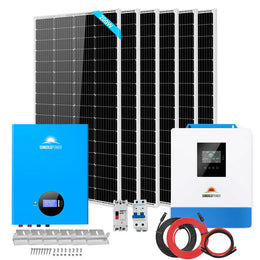
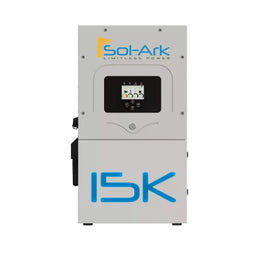
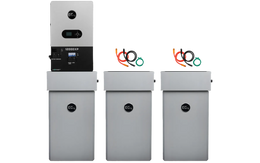
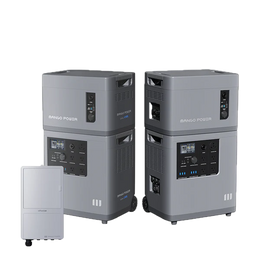


Battery chemistry decides how much of your battery you can actually use, how many years it lasts, how heavy it is, and whether it can sit in a garage in January. Three chemistries cover nearly every solar battery sold today: LiFePO4 (lithium iron phosphate, also written LFP), NMC lithium-ion (nickel manganese cobalt), and AGM (absorbent glass mat, a sealed lead-acid battery). This guide compares them with the same yardsticks, shows the cost and sizing math, and lists in-stock LiFePO4 batteries at 12V, 24V and 48V with prices checked on November 20, 2026.
LiFePO4 vs NMC vs AGM at a glance
| Factor | LiFePO4 (LFP) | Lithium-ion NMC | AGM (sealed lead-acid) |
|---|---|---|---|
| Usable depth of discharge | 90-100% | 80-90% | 50% recommended |
| Rated cycle life | 4,000-8,000 cycles | about 1,000-2,000 cycles | about 400-800 cycles at 50% depth |
| Round-trip efficiency | about 95%+ | about 90-95% | about 80-85% |
| Weight per usable kWh | about 20-23 lb | lightest (about 12-18 lb) | about 95-100 lb |
| Thermal stability | Highest; resists thermal runaway | Lower; needs tighter BMS and cooling | No thermal runaway, but can vent gas if overcharged |
| Charging below 32°F | Only with self-heating | Only with heating | Yes, at reduced current |
| Voltage under load | Flat (12V battery holds about 13.0-13.3 V most of the way) | Slopes gradually | Drops steadily; inverters cut out early |
| Upfront price per nameplate kWh | Mid ($175-$380 per usable kWh in our store) | Mid to high | Lowest upfront |
| Where you see it | Home batteries, rack batteries, RV/marine batteries, most new power stations | EVs, laptops, some older power stations and home batteries | Older RV, marine and backup banks |
AGM wins only on sticker price and cold charging, NMC only on weight. LiFePO4 wins on usable capacity, cycle life, efficiency and safety, which is why every battery we recommend below is LFP. For how cycle ratings turn into years on the wall, see our guide to how long solar batteries last.
How each chemistry works and why it matters
AGM is lead-acid with the electrolyte soaked into glass-fiber mats, so it is sealed and spill-proof. Lead plates slowly turn into hard lead sulfate if the battery is drained deep or left partly charged, which is why AGM makers rate cycle life at 50% depth of discharge and why an AGM bank that sits at 60% all winter loses capacity fast.
NMC lithium-ion packs a lot of energy into a small, light cell, which is why it dominates phones, laptops and EVs. The trade-off is heat tolerance: nickel-rich cathodes release oxygen at lower temperatures when abused, so a damaged or overcharged NMC cell is more likely to go into thermal runaway.
LiFePO4 is also lithium-ion, but with an iron-phosphate cathode. It stores a little less energy per pound than NMC but tolerates heat, deep discharge and thousands of cycles. Its 3.2 V cell voltage also lines up neatly with lead-acid systems: four cells in series make a 12.8 V battery that drops into a 12V system, sixteen make a 51.2 V "48V" battery. If you are deciding between 12V, 24V and 48V at the same time, read 12V vs 24V vs 48V solar systems first.

A daily-cycling solar system is exactly the use where LiFePO4 cycle life pays off.
Lifetime cost: price per usable kWh
Comparing batteries by price per nameplate kWh flatters AGM, because half of an AGM's label is off-limits. The fair numbers are price per usable kWh today and price per kWh delivered over the battery's life.
Lifetime energy = nameplate kWh x usable depth x rated cycles
- Two 12V 100Ah AGMs (2.56 kWh): 2.56 x 50% x 500 cycles = about 640 kWh
- A 2.56 kWh NMC pack: 2.56 x 80% x 1,500 cycles = about 3,075 kWh
- A 12V 200Ah LiFePO4 (2.56 kWh): 2.56 x 90% x 4,000 cycles = about 9,200 kWh

Put prices on that. A pair of good 12V 100Ah deep-cycle AGMs commonly sells for about $500-$700, which works out to roughly $0.80-$1.10 for every kWh they will ever deliver. The Sungold 12V 200Ah LiFePO4 at $589 delivers its 9,200 kWh for about $0.06 per kWh.
Here is what usable storage costs today across the in-stock LiFePO4 batteries in this guide (usable = 90% of nameplate unless the maker publishes a usable figure):
| Battery | Voltage | Nameplate | Usable | Price (Nov 20) | Price per usable kWh | Rated cycles |
|---|---|---|---|---|---|---|
| Sungold PowerMax 16.07 kWh | 51.2V | 16.07 kWh | 15.42 kWh | $2,696 | $175 | 8,000 |
| Sungold SG48200T Powerwall X | 51.2V | 10.24 kWh | 9.2 kWh | $2,151 ($2,001 after Black Friday $150 off) | $217-$234 | 8,000+ |
| Sungold 24V 100Ah | 25.6V | 2.56 kWh | 2.3 kWh | $530 | $230 | 4,000+ |
| Sungold 12V 200Ah | 12.8V | 2.56 kWh | 2.3 kWh | $589 | $256 | 4,000+ |
| Rich Solar ALPHA 2 LITE | 12.8V | 2.56 kWh | 2.3 kWh | $729.99 | $317 | 4,000+ |
| Rich Solar ALPHA 5 PRO | 51.2V | 5.12 kWh | 4.6 kWh | $1,749 ($1,649 with ECO100) | $358-$380 | 7,000+ |
| Typical 12V 100Ah AGM (reference) | 12V | 1.2-1.28 kWh | 0.6-0.64 kWh | about $250-$350 | about $390-$580 | 400-800 |
Weight, space and real usable capacity

In an RV, van or boat, weight is the big change. A typical 12V 100Ah AGM weighs about 60-65 lb and gives you about 0.64 kWh before you should stop. The 12V 200Ah ALPHA 2 LITE weighs 52.9 lb and gives you about 2.3 kWh.
Sizing math: RV or van using 1.5 kWh a day
Lights, a 12V compressor fridge, fans, a laptop and a water pump add up to about 1.5 kWh a day for many RVers. With one day of reserve:
- AGM: 1.5 kWh / 50% = 3.0 kWh nameplate = three 12V 100Ah batteries, about 190 lb.
- LiFePO4: 1.5 kWh / 90% = 1.67 kWh nameplate = one 12V 200Ah battery (2.56 kWh, with margin), 52.9 lb for the ALPHA 2 LITE.
Sizing math: home backup using 10 kWh overnight
A home that runs a fridge, internet, lights, a furnace blower and some outlets through the night uses roughly 10 kWh.
- AGM: 10 kWh / 50% = 20 kWh nameplate. At 48V that is 16-20 batteries of 12V 100Ah in strings of four, roughly 1,000-1,250 lb and a ventilated battery room.
- LiFePO4: 10 kWh / 90% = 11.1 kWh nameplate. One Sungold PowerMax 16.07 kWh (15.42 kWh usable, 271 lb) covers it with room to spare, or an SG48200T (10.24 kWh, 198.4 lb) plus a small battery.
For a fuller sizing walk-through by home size, see how many batteries you need for solar, and for wall, rack and floor formats see wall-mount vs server rack vs stackable batteries.
Cold weather, heat and safety
Cold. AGM's one real advantage: it accepts charge below freezing (at a reduced rate, with temperature-compensated voltage), though it loses a big share of its capacity in the cold. Standard LiFePO4 and NMC cells must not be charged below 32°F (0°C); a good BMS blocks charging to protect the cells. Discharging is fine down to about -4°F. The fix is a self-heating battery: the Sungold 12V 200Ah and 24V 100Ah start heating below 33.8°F and stop above 42.8°F, and the ALPHA 5 PRO's 150W heater starts below 41°F. The ALPHA 2 LITE has no heater, so keep it inside the heated part of an RV or cabin. More on this in our winter power outage backup guide.
Heat. Heat shortens every battery's life, and lead-acid suffers most: its life roughly halves for every 15-18°F above 77°F. LiFePO4 handles hot garages best of the three.
Safety. LiFePO4's iron-phosphate cathode is far more resistant to thermal runaway than NMC, and the batteries below carry UL 1973 cell or pack certification, with UL 9540A fire testing on the ALPHA 5 PRO and PowerMax. AGM cannot run away thermally in the same way, but it contains lead and acid and can vent hydrogen if a charger overcharges it, so it needs ventilation and should never sit in a sealed box. Whatever the chemistry, use correctly rated fuses or breakers and cables at the battery.
Charging settings, alternators and inverters
Switching chemistries is usually a settings change, not a new system, but the settings matter:
- Charge controller: choose the lithium or LiFePO4 profile, or a user profile with absorption about 14.2-14.6 V (12V), 28.4-29.2 V (24V) or 56.8-57.6 V (48V). Turn off equalization and temperature compensation. The ALPHA 2 LITE spec is 14.4 V; the ALPHA 5 PRO maximum is 57.6 V.
- Inverter low-voltage cutoff: raise it to suit LiFePO4. An AGM cutoff of 10.5 V is far below where a lithium battery is nearly empty, so let the BMS or a battery-monitor setting end the discharge instead.
- Vehicle alternator: lithium will pull as much current as the alternator gives and can overheat it. Use a DC-DC charger between the starter battery and the lithium house battery.
- RV converter: older converters charge at AGM voltages (around 13.6 V) and never fully charge lithium. Many RVs need a lithium-compatible converter or a converter with a lithium mode.
- Closed-loop communication: 48V rack and wall batteries talk to hybrid inverters over CAN or RS485. The ALPHA 5 PRO lists Victron, Sol-Ark, Growatt, SMA and others; the PowerMax lists Sol-Ark, Victron, EG4 and Sungold.
Which battery type should you buy?
- Daily-cycling solar of any size (RV, van, cabin, home): LiFePO4. The lifetime cost gap is too large to ignore.
- RV or van replacing AGMs in a heated space: a 12V 200Ah LiFePO4 like the ALPHA 2 LITE.
- Cabin, boat or trailer that sees freezing nights: a self-heating battery like the Sungold 12V 200Ah or 24V 100Ah.
- 48V home or off-grid system: rack or wall LiFePO4 with inverter communication - ALPHA 5 PRO, SG48200T or PowerMax.
- NMC: only where weight matters more than lifespan, such as a small carry-around power bank. We do not recommend NMC for fixed solar storage.
- AGM: a starter battery, a standby bank that cycles a few times a year, or an unheated site where a lithium battery cannot be warmed.
Best LiFePO4 batteries in stock (12V, 24V and 48V)
All six were active and in stock on November 20, 2026. Black Friday started today: some batteries get an automatic $150 off orders of $1,500+ (through December 1), and codes do not stack with it. Each card says exactly what applies. Browse every lithium option in our LiFePO4 battery collection or the Black Friday battery deals.
Rich Solar ALPHA 2 LITE 12V 200Ah

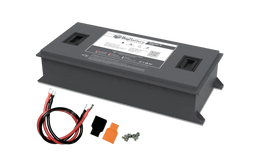
The simplest way out of a tired AGM bank. One 12V 200Ah ALPHA 2 LITE stores 2,560 Wh, delivers 200 A continuous (enough for a 2,000W inverter), and replaces two to three 100Ah AGMs at 52.9 lb. Individually fused cells, a full-protection BMS, a flame-retardant case and IP55 rating suit RV, van and marine use. Rich Solar is one of our priority brands. Check the size first: 20.9 x 8.1 x 8.5 in.
$729.99 (list $949); 2-pack $1,399; 3-pack $1,999. No code on the single or 2-pack; ECO100 takes $100 off the 3-pack ($1,899).
See price and stockSungold Power 12V 200Ah Self-Heating LiFePO4

The same 2.56 kWh as the ALPHA 2 LITE for $140 less, plus self-heating that switches on below 33.8°F and off above 42.8°F, an IP65 rating, an LCD and Bluetooth monitoring. It has a 200A BMS and can be wired into 12V, 24V or 48V banks. It is the value pick for cabins, boats and trailers that see frosty mornings.
$589. No code applies today.
See price and stockSungold Power 24V 100Ah Self-Heating LiFePO4

If your inverter or charge controller is 24V, a native 24V battery avoids wiring two 12V batteries in series. This 25.6V 100Ah pack stores 2,560 Wh at 45 lb, with a 100A BMS, self-heating below 33.8°F, IP65 and Bluetooth. Two in series make a 48V bank; packs of 2 and 4 are listed.
$530 (list $589); 2-pack $1,060; 4-pack $2,120. No code applies today.
See price and stockRich Solar ALPHA 5 PRO 48V 5.12 kWh

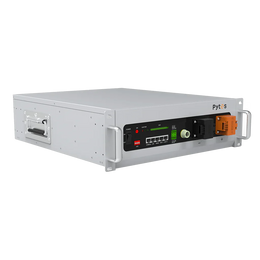
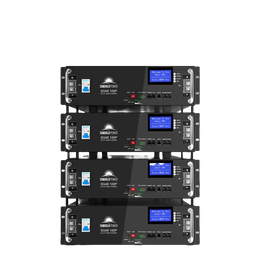
A 3U, 51.2V 100Ah server-rack battery with 7,000+ cycles at 80% depth, a 10-year warranty, Wi-Fi and Bluetooth monitoring, and a 150W heater that brings the cells up to charging temperature on its own. It is UL 1973 and UL 9540A certified, talks CAN or RS485 with major inverter brands, and parallels up to 30 units; the optional rack holds six (30.72 kWh).
$1,749 (list $1,999); $1,649 with code ECO100 (orders $1,500+). 2-pack $3,449, 3-pack $5,149.
See price and stockSungold Power SG48200T 10.24 kWh Powerwall X

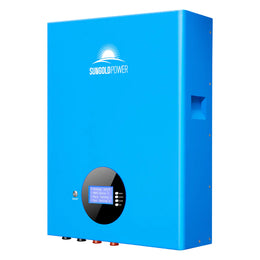
A 51.2V 200Ah wall-mounted LiFePO4 with a 200A BMS, 8,000+ cycle rating, LCD display and a 10-year warranty. Up to 32 can be paralleled, and the box includes the wall bracket and communication cable.
$2,151 (list $2,390). Black Friday $150 off applies automatically on orders $1,500+ through December 1 (about $2,001); no code needed, and codes do not stack.
See price and stockSungold Power PowerMax 16.07 kWh Outdoor

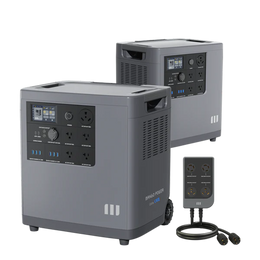
One floor-standing cabinet with 16.07 kWh (15.42 kWh usable), 7.68 kW of rated DC power, an IP65 enclosure for indoor or outdoor installation, a touch screen and Wi-Fi/Bluetooth app. It is UL 1973 and UL 9540A certified and CEC listed, rated for 8,000 cycles at 80% depth with a 10-year warranty, and forms a UL 9540 system with the Sungold SGS-12K18MAX hybrid inverter.
$2,696 (list $2,995). No code applies today.
See price and stockWhat buyers ask before switching from AGM to lithium
These questions come from what people search before buying a solar battery (Search Console queries such as "12v lithium ion battery for solar", "best solar battery" and "lithium battery for solar") and from the questions Google shows for this topic.
Can I drop a LiFePO4 battery into my AGM spot without changing anything?
Physically, often yes - a 12V LiFePO4 fits a group 31 or 8D space in many RVs and boats. Electrically, check three things: the charge controller or converter has a lithium profile, the inverter's low-voltage cutoff suits lithium, and the alternator charges through a DC-DC charger. Skip those and the battery either never fills or the alternator runs hot.
Is LiFePO4 the same as lithium-ion?
LiFePO4 is one type of lithium-ion battery. When a product just says "lithium-ion" with no chemistry, it is often NMC. Look for LiFePO4, LFP or lithium iron phosphate on the spec sheet; every battery in this guide states it.
Can I mix AGM and lithium batteries in one bank?
No. They charge at different voltages and discharge along different curves, so in parallel the lithium battery does most of the work while the AGM sits partly charged and sulfates. Replace the whole bank at once, or keep AGM for engine starting and lithium for the house load on a separate charger.
Do I need a new inverter or charge controller?
Usually not if they have programmable charge voltages. Most MPPT controllers sold in the last several years include a lithium preset. A 48V home battery should be paired with an inverter it can communicate with (CAN or RS485) so the inverter knows the true state of charge.
FAQ
Is LiFePO4 better than AGM for solar?
For almost every solar system that cycles daily, yes. A LiFePO4 battery delivers 90% or more of its rated capacity, lasts 4,000-8,000 cycles and weighs about 60% less, so it costs roughly a tenth as much per kWh delivered over its life. AGM still makes sense for rarely used standby banks, very tight budgets or charging below freezing without heated lithium.
How long do AGM batteries last in a solar system?
Typically 3-5 years with daily cycling. A good deep-cycle AGM is rated for roughly 400-800 cycles at 50% depth of discharge, and fewer if it is often drained deeper or left partly charged. Used only for occasional backup and kept on float, it can last longer.
Is LiFePO4 safer than lithium-ion?
LiFePO4 is a type of lithium-ion battery, and it is the most thermally stable common type. Its iron-phosphate cathode does not release oxygen when it overheats, so it resists thermal runaway far better than the NMC (nickel manganese cobalt) cells used in many EVs, laptops and older power stations. That is why most home storage batteries now use LFP.
Can LiFePO4 batteries be charged below freezing?
Not safely without heat. Standard LiFePO4 cells should not be charged below 32°F (0°C), although they can discharge down to about -4°F. Self-heating models warm the cells first: the Sungold 12V and 24V batteries start heating below 33.8°F, and the Rich Solar ALPHA 5 PRO uses a 150W heater that starts below 41°F.
Are AGM batteries still worth buying?
Only in a few cases: a starter or standby battery that rarely cycles, a short-term project where upfront price matters most, or a cold, unheated site where nothing can warm a lithium battery. For daily solar cycling, a 12V 200Ah LiFePO4 at $589-$730 replaces two to three 100Ah AGMs and outlasts several sets of them.
What charge voltage does a 12V LiFePO4 battery need?
Most 12V LiFePO4 batteries charge at 14.2-14.6 V absorption (the ALPHA 2 LITE spec is 14.4 V) with float around 13.5 V or float turned off. Do not use an AGM or flooded profile with equalization or temperature compensation; pick the controller's lithium or LiFePO4 profile, or set the values from the battery manual.
Sources for chemistry ranges: manufacturer specifications on the linked product pages and Victron Energy's lithium vs AGM comparison. Product prices and codes change; the figures above were checked on November 20, 2026.

Serhii Dovzhenko, Solar & Energy Storage Specialist at Eco Solar Kits · LinkedIn
Serhii is based in Vancouver, BC, and works on product data, system sizing and buyer guides for Eco Solar Kits. He attends solar and energy storage industry conferences and is involved in the community of electricians in Vancouver, BC. Credit for the data verification in this guide goes to Adsec.ca.


