

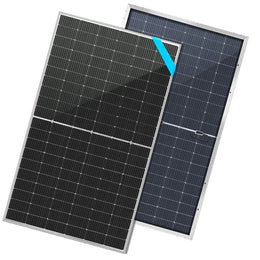
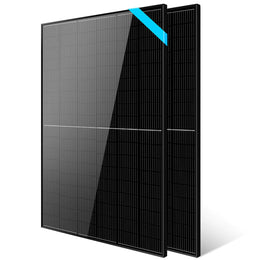
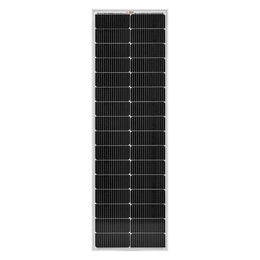
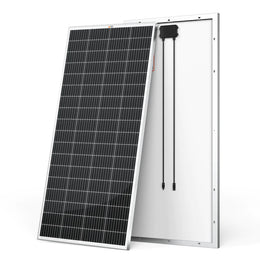


The 100-watt panel is the entry point to solar: light enough to carry, cheap enough to try, and the building block of most 12V setups on RVs, vans, boats, sheds and cabins. It is also the size people most often over-expect from. This guide shows what one panel really delivers per day, what that energy runs, how long it takes to fill common batteries, and when two or four panels make more sense. Every product below was in stock on November 19, 2026, with live prices.
How much power does a 100-watt solar panel produce?
The "100 watts" on the label is the output under lab conditions (1,000 W/m² of light at a 25 °C cell temperature). On a real roof the panel runs hotter, the sun is rarely straight overhead, and some energy is lost in cables and the charge controller. A fair planning figure is 75% of the rating during each peak sun hour.
Daily energy = 100 W x peak sun hours x 0.75
- 3 peak sun hours (northern winter, cloudy regions): about 225 Wh a day
- 4 peak sun hours (much of the US in spring and fall): about 300 Wh
- 5 peak sun hours (sunny summer days, the South): about 375 Wh
- 6 peak sun hours (desert Southwest in summer): about 450 Wh
Into a 12V lithium battery (12.8V nominal), 375 Wh is about 29 amp-hours a day. At its best moment of the day a typical 100W panel pushes around 5.0-5.9 amps at 17-20 volts (its Imp and Vmp). Your local sun-hour figure is free from NREL's PVWatts calculator.

Rated watts x peak sun hours x 0.75. Doubling the panels doubles the daily energy.
MPPT vs PWM matters more on small systems. A PWM controller pulls the panel down to battery voltage (about 13.6V while charging), so a panel rated 5.38 A delivers roughly 73 W at best. An MPPT controller converts the panel's 18-19V into extra charging current and keeps close to the full 100 W. On a single panel that is a 20-25% difference in daily energy. Every portable power station already has an MPPT input built in.
What can a 100W solar panel run?
A solar panel does not run anything directly; it refills a battery or power station, and the battery runs your devices. So the useful question is: what fits inside roughly 300-375 Wh a day? The table uses typical draws; check the label on your own device.
| Device | Typical use | Wh per day | One 100W panel (5 sun hours)? |
|---|---|---|---|
| LED lights (4 x 5 W) | 5 hours | 100 | Yes, with room to spare |
| Phone charging | 2 full charges | 30 | Yes |
| Laptop (60 W) | 3 hours | 180 | Yes |
| Starlink Mini (25-40 W) | 6 hours | 150-240 | Yes |
| Roof vent fan (30 W) | 8 hours | 240 | Yes |
| 32-inch LED TV (40 W) | 3 hours | 120 | Yes |
| CPAP, no humidifier (30-40 W) | 8 hours | 240-320 | Borderline - fine in summer, short in winter |
| CPAP with heated humidifier (60-90 W) | 8 hours | 480-720 | No - plan 200-300 W of panels |
| 12V compressor fridge | 24 hours | 300-500 | Borderline - plan 200 W in hot weather |
| Household refrigerator | 24 hours | 1,000-2,000 | No - plan 400-800 W plus a large battery |
| Microwave, AC, space heater | Any | 500+ per hour | No |
The pattern: one 100W panel covers the "always on, low watt" loads of a weekend trip - lights, phones, a laptop, a fan. Add a fridge or CPAP and you are into 200-400 W territory, which is where the 100-watt panel kits in 2-, 3- and 4-panel packs come in. For whole-day loads in a cabin or RV, the 1000-watt solar panel setup guide shows how a bigger array scales.
Charge times: phones, power stations and 12V batteries
Charge time is simply battery capacity divided by what the panel really delivers per hour of strong sun (about 75 W). Divide the result by your peak sun hours to get days.

Battery Wh / (100 W x 0.75). Green bars finish in one sunny day.
- Phones, tablets, laptops: under an hour of good sun each.
- A 300 Wh power station: about 4 sun hours, one good day.
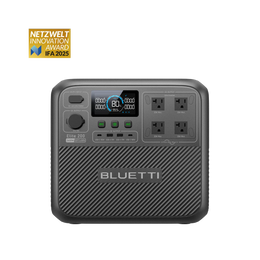
- A 1 kWh power station such as the Anker SOLIX C1000 Gen 2: about 13.7 sun hours, or 2-3 sunny days on one panel. The C1000 Gen 2 accepts up to 600 W of solar, so four to six 100W panels refill it in an afternoon.
- A 12V 100Ah LiFePO4 battery (1,280 Wh): about 17 sun hours from empty, or 3-4 days. From a more typical 20% state of charge, about 2.7 days.
Rule of thumb for 12V lithium banks: plan 100-200 W of panels for every 100Ah if you want to refill in one or two days. Our charge-time guide for power stations covers bigger stations and multi-panel arrays.
100W solar panels compared
All six panels below are 100 W class and in stock today. They differ in format (rigid, slim, flexible, folding), efficiency, connectors and warranty, which decides where each fits.
| Panel | Type | Efficiency | Vmp / Imp | Weight | Connector | Warranty | Price today |
|---|---|---|---|---|---|---|---|
| Rich Solar MEGA 100 | Rigid, 39.0 x 21.3 in | 22.6% | 18.6 V / 5.38 A | 13.2 lb | MC4 | 25-yr output | $109.99 (list $139) |
| Rich Solar MEGA 100 SLIM | Rigid narrow, 50.0 x 15.7 in | 25.1% (N-type TOPCon) | 19.6 V / 5.01 A | 12.4 lb | MC4, 4 ft leads | 25-yr output | $129 (list $159) |
| Rich Solar MEGA 100 FLEX | Flexible, 0.1 in thick | 22.8% | 17.1 V / 5.85 A | 4.8 lb | MC4, 3 ft leads | 1 year | $169 (list $195) |
| Rich Solar MEGA 100 Briefcase | Folding, built-in 10A controller | 23.2% | 18.6 V / 5.38 A | 15.7 lb | MC4, 5 ft leads | 25-yr output, 10-yr workmanship | $229.99 (list $289) |
| Anker SOLIX PS100 Bifacial | Folding, bifacial | 25%+ | 21.6 V / 4.63 A | 6.2 lb | XT-60i cable included | 5 years | $249.99 (list $399.99) |
| Sungold Power 100W panels (2-pack) | Rigid, sold in 2/4/6/10 packs | Grade A mono | 19.1 V / 5.24 A | 13.05 lb each | MC4 | 25-yr tiered output | $165 per 2 ($82.50 each) |
Price per watt ranges from about $0.80 (Sungold 10-pack, $799) and $1.10 (MEGA 100) up to $2.50 for the folding bifacial Anker. You pay for portability, low weight and the built-in controller, not for more energy: all six land within a few percent of each other per day in the same sun. More on that trade-off in lightweight vs rigid solar panels.

Framed rigid panels are the cheapest watts and last longest on a fixed roof or ground mount.
How many 100W panels do you need?
Start from your daily watt-hours (add up the table above for your devices), add 20% margin, then divide by what one panel makes in your season.
Panels = daily Wh x 1.2 / (100 x sun hours x 0.75)
Example: a van with a 12V fridge (400 Wh), lights (100 Wh), phones (30 Wh) and a laptop (180 Wh) uses about 710 Wh. With 20% margin that is 852 Wh. At 4 sun hours one panel makes 300 Wh, so you need 852 / 300 = 2.8, round up to three 100W panels, paired with a 12V 100-200Ah battery so a cloudy day does not leave the fridge dark.
| Array | Daily energy (4-5 sun hours) | Good for | MPPT controller (12V battery) | Battery to pair | Example price today |
|---|---|---|---|---|---|
| 1 x 100W | 300-375 Wh | Lights, phones, laptop, fan; weekend trickle charging | 10 A | 12V 50-100Ah | MEGA 100: $109.99 |
| 2 x 100W | 600-750 Wh | Adds a 12V fridge or CPAP without humidifier | 20 A | 12V 100Ah | MEGA 100 2-pack: $219.98; Sungold 2-pack: $165 |
| 3 x 100W | 900-1,125 Wh | Van or small RV with fridge, fan, Starlink | 30 A | 12V 100-200Ah | MEGA 100 3-pack: $328.97 |
| 4 x 100W | 1,200-1,500 Wh | Full-time van, shed or cabin weekend use | 30-40 A (or 20 A on 24V) | 12V 200-300Ah or 24V 100Ah | MEGA 100 4-pack: $435.96; Sungold 4-pack: $325 |
Controller size comes from array watts divided by battery charging voltage: 400 W / 13.6 V is about 29 A on a 12V battery, but only about 15 A on a 24V battery. Past four panels, a 24V system usually saves money on the controller and wire; our 12V solar panel kit setup guide walks through the whole 12V build step by step.
Wiring a 100W panel: controller, battery, series or parallel
- Power station? Skip the controller. Plug the panel's MC4 leads into the station's solar cable (or the Anker PS100's included XT-60i cable). Check the station's solar input voltage range covers the panel's open-circuit voltage.
- 12V battery? Panel, then charge controller, then battery, in that order of thinking, but connect the battery to the controller first so it can detect the system voltage, then the panel. A fuse on the controller-to-battery wire close to the battery protects the cable.
- Two or more panels in series add voltage: two MEGA 100 panels give 45.6 V open-circuit (and about 51 V on a freezing morning). That needs an MPPT controller rated 60 V or higher; a 100 V controller is the safe choice. Series wiring keeps current low, so thinner wire works over long runs.
- Panels in parallel add current: two MEGA 100 panels give about 11.6 A short-circuit current at 22.8 V. Parallel works with any 12V controller and handles partial shade better. With three or more strings in parallel, fuse each string (the MEGA 100's series fuse rating is 10 A).
Our series vs parallel wiring guide has the full voltage math and cold-weather correction.
Best 100W solar panels in stock
Rich Solar MEGA 100 Rigid 12V Panel

The classic 100W framed panel done well: 22.6% efficient monocrystalline cells, an IP67 junction box and MC4 connectors, pre-drilled frame holes for Z-brackets or a tilt mount, and a 25-year output warranty. At 39 x 21.3 inches and 13.2 lb it fits most RV roofs, shed roofs and ground stands. Rich Solar is one of our priority brands, and you can buy it as a single or in 2-, 3- and 4-panel packs at the same per-panel price.
$109.99 (list $139); 4-pack $435.96. No code applies today.
See price and stockRich Solar MEGA 100 SLIM (N-type TOPCon)

Only 15.7 inches wide, so it fits between roof vents, rails and fans where a standard panel will not. The 16-busbar N-type TOPCon cells reach 25.1% efficiency, the panel weighs 12.4 lb, and the listing shows UL 61730, IEC 61215 and CSA certification. It is rated for 5,400 Pa snow loads, which also makes it a good small panel for cabin roofs.
$129 (list $159). No code applies today.
See price and stockRich Solar MEGA 100 FLEX

At 0.1 inch thick and 4.8 lb, the FLEX glues or screws onto a curved camper roof, a boat bimini or a teardrop trailer where glass panels will not sit flat. Output is the same 100 W class (22.8% cells, 17.1 V / 5.85 A), with an IP68 junction box and MC4 connectors. Leave an air gap or mount on a light-colored surface if you can: flexible panels run hotter than framed ones.
$169 (list $195). No code applies today.
See price and stockRich Solar MEGA 100 Briefcase

Folds to 25.2 x 18.1 inches with a handle, opens on built-in kickstands, and has a waterproof 10A charge controller built in, so you can clip it to a 12V camper or boat battery without buying anything else. Park the RV in the shade and set the panel in the sun on its 5 ft leads. 23.2% cells, 25-year output and 10-year workmanship warranty.
$229.99 (list $289); 2-pack $449.99. No code applies today.
See price and stockAnker SOLIX PS100 Bifacial

A 6.2 lb folding panel with 25%+ N-type cells on both sides; the rear face adds up to 10% more power when the panel stands over light ground, sand or snow. IP68 rated, with a fixed 35° stand, two 8.2 ft cables and an XT-60i cable for Anker stations. Pair two or three with the Anker SOLIX C1000 Gen 2 ($549.99, 1,024 Wh, 2,000 W output, up to 600 W solar) for a camping or outage kit.
$249.99 (list $399.99). No code applies today.
See price and stockSungold Power 100W Monocrystalline Panels (2, 4, 6 or 10 pack)

Sold in packs only, which is why the per-panel price is the lowest in the store: $165 for two (wire them in series for a 24V battery, or in parallel for 12V), up to $799 for ten. Each panel is 100 W (19.1 V / 5.24 A), with an IP65 junction box, IP67 connectors and a tiered 25-year output warranty (95% at 5 years, 90% at 10, 80% at 25). A strong pick for a shed, chicken coop or cabin array you build up over time.
$165 per 2-pack; $325 per 4-pack; $799 per 10-pack. No code applies today.
See price and stockBattery to pair: the Rich Solar ALPHA 1 LITE 12V 100Ah ($419.99, 1,280 Wh, 4,000 cycles, 24.3 lb) is the usual match for one to two 100W panels. More choices in 12V batteries, and every size of panel in 100W solar panels, flexible panels and portable panels.
What buyers ask before buying a 100W panel
These questions come from what people search before landing on our 100W panel pages and from the questions Google shows for this topic. Answers use the specs of the panels above.
"Can I use a 100 watt folding panel without a charge controller?" Only with a power station, which has its own MPPT controller inside. Connected straight to a 12V battery, a panel's 22-23 V open-circuit voltage will overcharge it. The MEGA 100 Briefcase solves this with its built-in 10A controller.
"Is there a 100 watt 24 volt solar panel?" Almost every 100W panel is a "12V" panel (17-20 Vmp). For a 24V battery, wire two in series; that is how the Sungold 2-pack is meant to be used.
"Should I buy a 50W or 60W panel instead?" Only if space or weight is the limit. A 100W rigid panel costs barely more than a 50-60W panel and makes twice the energy, so for battery maintenance on a boat or trailer the 100W usually wins.
"Monocrystalline or polycrystalline?" All panels we sell in this class are monocrystalline (or N-type TOPCon), which is more efficient, so a 100W panel is smaller and handles heat better.
"One 200W panel or two 100W panels?" Two 100W panels give more layout freedom on small roofs and keep working better when one is shaded; one 200W panel means fewer connections. The daily energy is the same. Rich Solar's MEGA 200 12V ($229.99) is the 200W alternative.
FAQ
How many amps does a 100 watt solar panel produce?
About 5.0-5.9 amps at peak sun, depending on the model (the MEGA 100 is rated 5.38 A at 18.6 V). Over a day with 5 peak sun hours and an MPPT controller, that adds up to roughly 29 amp-hours into a 12V lithium battery.
Can a 100W solar panel charge a 12V 100Ah battery?
Yes, but slowly. A 12V 100Ah LiFePO4 battery stores 1,280 Wh, and one panel delivers about 375 Wh on a sunny day, so a full recharge from empty takes about 3-4 sunny days, or about 2.7 days from 20%. Two panels halve that.
Can a 100 watt solar panel run a refrigerator?
Not a household refrigerator, which uses 1-2 kWh a day. An efficient 12V compressor fridge uses 300-500 Wh a day, which one panel can cover only in strong summer sun; plan two 100W panels and a 100Ah battery for a fridge.
Do I need a charge controller for a 100W solar panel?
Yes, if you charge a battery directly; a 10A MPPT controller is the right size for one panel. No, if you charge a portable power station, because it has a controller built in.
How big is a 100 watt solar panel?
A standard rigid 100W panel is about 39 x 21 inches and 12-13 lb. Slim versions are about 50 x 15.7 inches, flexible ones weigh under 5 lb, and folding briefcase panels pack down to about 25 x 18 inches.
Is 100 watts of solar enough for an RV or van?
It is enough for lights, phones, a laptop, a fan and battery maintenance. With a 12V fridge, CPAP or Starlink running daily, most RVs and vans need 200-400 W of panels and a 100-200Ah lithium battery.

Serhii Dovzhenko, Solar & Energy Storage Specialist at Eco Solar Kits · LinkedIn
Serhii is based in Vancouver, BC, and works on product data, system sizing and buyer guides for Eco Solar Kits. He attends solar and energy storage industry conferences and is involved in the community of electricians in Vancouver, BC. Credit for the data verification in this guide goes to Adsec.ca.


