

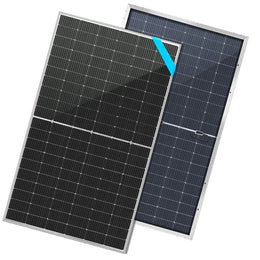
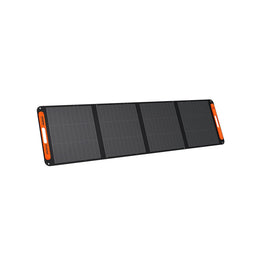

"Lightweight" is one of the most loosely used words in solar. It gets printed on glass-free flexible laminates, on small framed panels and on folding camping panels, and those three products behave very differently on a roof. This guide puts numbers on the difference: pounds per square foot, watts per pound, price per watt and warranty years, using seven panels that are in stock at Eco Solar Kits today. If you need a folding panel for a power station, that is a separate job, covered in our portable solar panel guide.
What "lightweight" means: three kinds of panel
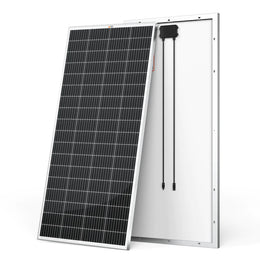
- Rigid (framed glass) panels. Solar cells behind tempered glass (3.2 mm on the Rich Solar panels here) in an aluminum frame. This is the standard panel for houses, sheds, RV roofs and ground mounts. See all of them in the rigid solar panels collection.
- Flexible panels. The same kind of crystalline cells laminated between thin polymer sheets, with no glass and no frame. They are about a tenth of an inch thick and can follow a curve. The flexible solar panels collection holds the ones we carry.
- "Lightweight" framed panels. Small or narrow rigid panels sold for vans, boats and manufactured homes. They are lighter to lift because they are smaller. As the next section shows, they are not lighter for the area they cover.
Folding portable panels are a fourth type, made to be carried and packed away, not mounted. A folding panel left on a roof all year will not last like a bolted glass panel.
Weight math: pounds per square foot and per watt
Two numbers decide whether a panel suits a weak or curved roof. Pounds per square foot = panel weight / (length x width / 144), with the size in inches. Watts per pound = rated watts / panel weight. We ran both for every pick, using the weights and dimensions on each product listing.

The chart shows the real divide. Every framed glass panel lands between 2.2 and 2.5 lb per square foot, whether it is sold as "slim", "lightweight" or a full-size house panel. The flexible panel is the only one that is truly light for its area: 0.76 lb per square foot, about a third of the glass panels.
Worked example: 400W on a van roof.
| 400W array | Panels | Panel weight | Roof area | Price |
|---|---|---|---|---|
| Flexible | 4 x MEGA 100 FLEX | 19.2 lb | 25.2 sq ft | $676 |
| Rigid, small panels | 4 x MEGA 100W rigid | 52.8 lb + brackets | 23.1 sq ft | $435.96 |
| Rigid, large panels | 2 x MEGA 200W 24V | 48.0 lb + brackets | 21.8 sq ft | $469.98 |
Going flexible saves about 30 lb on this roof and costs $206 to $240 more. Whether 30 lb matters depends on the vehicle: on a pop-top or a small trailer near its payload limit it does, on a full-size van it rarely does.
Worked example: a 2.2 kW array on a building. Five Sungold 440W panels weigh 5 x 46.3 = 231.5 lb and cover about 105 square feet, which is 2.2 lb per square foot. Add rails and brackets and the usual planning figure is about 3 lb per square foot of array. That array makes about 2,200 x 4.5 x 0.77 = 7,600 Wh on a day with 4.5 peak sun hours, using the same 0.77 real-world factor as our other guides. To size the whole system, see what size solar system you need.
Lifespan, heat and warranty
Weight is where flexible panels win. Lifespan is where they lose, for three reasons.
- No glass. Tempered glass shields the cells from hail, grit and UV for decades. A polymer top sheet scratches, hazes and wears much sooner.
- Heat. A framed panel on brackets has moving air behind it. A flexible panel glued flat to a roof does not, so it runs hotter. The MEGA 100 FLEX listing gives a temperature coefficient of -0.35% per degree C, so a panel running 20 C hotter makes about 7% less power (20 x 0.35), and heat also ages the laminate.
- Flexing. Crystalline cells are thin and brittle. Repeated bending, foot traffic and vibration cause micro-cracks that cut output over time.
The warranties reflect this. The rigid panels in this guide carry 25 or 30-year output warranties. The flexible panel carries a 1-year materials and workmanship warranty. A warranty is not a lifespan, and a well-mounted flexible panel can work for years, but it tells you how long the maker is willing to stand behind each design.
| Rigid (framed glass) | Flexible (glass-free) | |
|---|---|---|
| Weight | 2.2 to 2.5 lb per sq ft | 0.76 lb per sq ft |
| Thickness | 1.2 to 1.4 in | 0.1 in |
| Price per watt (in stock) | $0.50 to $1.29 | $1.69 |
| Warranty (in stock) | 25 to 30-year output | 1 year |
| Mounting | Brackets, rails, tilt or ground mounts | Adhesive, screws through grommets, or both |
| Cooling | Air gap behind the panel | Little or none when bonded flat |
| Surface | Flat only | Flat or gently curved |
| Best for | Houses, sheds, cabins, flat RV roofs, ground mounts | Curved van and boat roofs, pop-tops, weight-limited roofs |

Framed glass panels on brackets keep an air gap behind the cells, which helps them run cooler and last longer.
7 lightweight and rigid panels compared
Prices are for one panel, or the smallest pack where a panel is sold in packs. "Best $ per W" uses the 4-pack for the MEGA 100 and MEGA 200 and the 8-pack for the Sungold panels. No discount code applies to these seven panels today.
| Panel | Type | Watts | Price | Best $ per W | Weight | Size (in) | Lb per sq ft | W per lb | Warranty |
|---|---|---|---|---|---|---|---|---|---|
| Rich Solar MEGA 100 FLEX | Flexible | 100 | $169 | $1.69 | 4.8 lb | 57.8 x 15.7 x 0.1 | 0.76 | 20.8 | 1 yr |
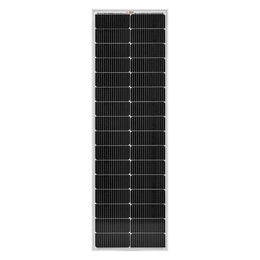
| Rich Solar MEGA 100 SLIM | Rigid, narrow | 100 | $129 | $1.29 | 12.4 lb | 50.0 x 15.7 x 1.2 | 2.27 | 8.1 | 25 yr output |
| Rich Solar MEGA 150W | Rigid, compact | 150 | $169 | $1.13 | 18.1 lb | 44.0 x 26.4 x 1.2 | 2.24 | 8.3 | 25 yr output |
| Rich Solar MEGA 100W | Rigid | 100 | $109.99 | $1.09 | 13.2 lb | 39.0 x 21.3 x 1.2 | 2.29 | 7.6 | 25 yr output |
| Rich Solar MEGA 200W 24V | Rigid | 200 | $239.99 | $1.12 | 24.0 lb | 58.7 x 26.8 x 1.2 | 2.20 | 8.3 | 25 yr output |
| Sungold Power 440W N-Type | Rigid, house size | 440 | $797 (2-pack) | $0.50 | 46.3 lb | 67.8 x 44.65 x 1.38 | 2.20 | 9.5 | 30 yr linear |
| Sungold Power 560W Bifacial | Rigid, bifacial | 560 | $980 (2-pack) | $0.53 | 70.4 lb | 89.8 x 44.7 x 1.4 | 2.53 | 8.0 | 30 yr linear |

Two patterns stand out. Big panels are far cheaper per watt, so on a building the 440W class is the default. And the flexible panel costs about 55% more per watt than the rigid 100W panel beside it, with a much shorter warranty. You pay for the weight saving twice: once at checkout and again in years of service.
Where each type fits
| Surface or job | Better type | Why | Pick |
|---|---|---|---|
| House or garage roof | Rigid, 400W class | Lowest cost per watt, 30-year warranty, UL 61730 for permits | Sungold 440W |
| Ground mount or carport | Rigid, bifacial | Rear side gains from reflected light; weight is not a limit | Sungold 560W |
| Shed or cabin roof | Rigid, 150W to 200W | One person can lift it; suits 12V and 24V controllers | MEGA 150W or MEGA 200W 24V |
| Flat RV or trailer roof | Rigid, 100W to 200W | Brackets leave an air gap; long warranty | MEGA 100W |
| Van roof with fans and vents | Rigid, narrow | 15.7 in width fits between fixtures | MEGA 100 SLIM |
| Curved roof, pop-top, boat deck | Flexible | Follows the curve; 4.8 lb | MEGA 100 FLEX |
| Roof that cannot carry glass | Flexible or ground mount | 0.76 lb per sq ft, or no roof load at all | MEGA 100 FLEX |
| Campsite, moved daily | Folding portable | Made to be carried and stored | See the portable guide |
For a full RV system with controller and battery, our RV solar kit guide has complete builds, and the 12V solar panel kit setup guide covers the wiring steps. Pallet buyers can compare bulk prices in the commercial solar panel guide.
The 7 picks in stock
1. Rich Solar MEGA 100W 12V Rigid

$109.99 (list $139, no code) - 4 for $435.96, $1.09 per watt
The plain rigid panel that suits most RV, trailer, shed and boat jobs. It measures 39.0 x 21.3 x 1.2 in and weighs 13.2 lb, so one person can carry it up a ladder. Cells are rated up to 22.6%, the glass is AR-coated and tempered, and the panel is rated for 5,400 Pa snow and 2,400 Pa wind loads. Working voltage is 18.6 V (22.8 V open-circuit), which suits any 12V charge controller. The 25-year performance warranty promises 80% output at year 25. Expect about 350 Wh per panel on a 4.5 sun-hour day.
- Lowest price per watt of the small panels
- 25-year performance warranty
- Easy size to handle and mount
- 2.29 lb per sq ft, needs a flat surface
- Listing shows FCC and CE marks only
2. Rich Solar MEGA 100 FLEX 12V

$169 (list $195, no code) - $1.69 per watt
The one to buy when glass will not work. At 4.8 lb and 0.1 in thick it adds 0.76 lb per square foot, and it has both pre-drilled holes and an adhesive backing, so it can go on without racking. The 57.8 x 15.7 in strip shape suits the edge of a van roof or a boat deck. Cells are rated up to 22.8% with a 0 to +5W tolerance; working voltage is 17.1 V (20.4 V open-circuit) and the junction box is IP68. The listing rates the bend at up to 360 degrees. We would still mount it once on a gentle curve and leave it there, because repeated flexing is what cracks cells in any flexible panel.
- A third of the weight of glass per square foot
- No brackets or rails needed
- Fits curved surfaces
- 1-year warranty
- Highest price per watt here
- Runs hotter when bonded flat
3. Rich Solar MEGA 100 SLIM 12V

$129 (list $159, no code) - $1.29 per watt
A framed glass panel only 15.7 in wide, the same width as the flexible panel, built for the strips of roof left beside a fan, a vent or an AC unit. N-type TOPCon cells are rated up to 25.1%, it weighs 12.4 lb, and it comes in silver or black. Working voltage is 19.6 V (23.6 V open-circuit) with 4 ft MC4 leads. It is certified to UL 61730, IEC 61215 and CSA standards and carries the 25-year performance warranty. If the surface is flat and only the width is tight, take this over a flexible panel.
- Narrow shape with a 25-year warranty
- TOPCon cells, UL 61730
- Lightest framed panel here
- Costs $19 more than the standard 100W
- Still 2.27 lb per sq ft
4. Rich Solar MEGA 150W 12V Lightweight

$169 (list $199, no code) - $1.13 per watt
Sold as a lightweight panel, and at 18.1 lb it is easy to lift, but its real strength is power for its size: 150W from 44.0 x 26.4 in, or 18.6 W per square foot, using 18-busbar N-type TOPCon cells rated up to 25.3%. It has 3.2 mm tempered glass, 14 pre-drilled holes for Z-brackets or tilt mounts, UL 61730 certification, a 25-year output warranty and a 10-year workmanship warranty. Working voltage is 17.5 V at 8.57 A. Same price as the flexible 100W panel, with 50% more power.
- 150W in a short, wide footprint
- 25-year output + 10-year workmanship
- UL 61730
- 2.24 lb per sq ft, like other glass panels
- 10 A series fuse rating limits parallel wiring without fuses
5. Rich Solar MEGA 200W 24V

$239.99 (list $279, no code) - 4 for $899.96, $1.12 per watt
Two of these replace four 100W panels with half the brackets and half the roof connections, and slightly less weight (48 lb against 52.8 lb). N-type TOPCon cells are rated up to 24.8% behind 3.2 mm glass. The panel measures 58.7 x 26.8 x 1.2 in and weighs 24.0 lb. Its 36.3 V working voltage (43.5 V open-circuit) needs an MPPT controller on a 12V battery and suits 24V systems well.
- Fewer panels and connections
- 8.3 W per pound
- 25-year performance warranty
- Needs an MPPT controller on 12V
- Too long for some van roofs
6. Sungold Power 440W N-Type UL61730

2 for $797 - 8 for $1,760, $0.50 per watt (no code)
The full-size panel for a home, garage or large shed. It is the best of the seven on watts per pound (9.5) and watts per square foot (20.9), and no heavier for its area than the small panels at 2.20 lb per square foot. Each panel is 67.8 x 44.65 x 1.38 in and 46.3 lb, so plan on two people. It is UL 61730 certified and CEC listed, which most permit offices ask for, and carries a 30-year linear power warranty. Open-circuit voltage is 39.03 V, so check string length against your inverter's input limit.
- Lowest price per watt in this guide
- UL 61730, CEC listed
- 30-year linear power warranty
- 46.3 lb, a two-person lift
- Sold in packs of two or more
7. Sungold Power 560W Bifacial N-Type

2 for $980 - 8 for $2,365, $0.53 per watt (no code)
The heaviest panel here and the right one when weight does not matter. Each bifacial panel is 89.8 x 44.7 x 1.4 in and 70.4 lb (2.53 lb per square foot), and the rear side adds output from light reflected off gravel, snow or a light roof under a carport. Open-circuit voltage is 50.09 V. It carries a 30-year linear power warranty and a 12-year materials warranty. The listing shows CE and TUV marks and no UL 61730, so ask your permit office before using it on a grid-tied job.
- Most watts per panel
- Rear-side gain on ground mounts
- 30-year linear power warranty
- 70.4 lb per panel
- No UL 61730 on the listing
Browse the full range in solar panels, or the smaller formats in 12V solar panels and lightweight solar panels for mobile homes.
Mounting tips for each type
- Rigid panels: use brackets or rails that leave at least an inch of air under the frame. Seal every roof penetration, and use the frame's mounting holes, not new ones drilled through it.
- Flexible panels: clean and dry the surface, bond the full perimeter so wind cannot get under an edge, and avoid spots where people step. Where you can, bond the panel to a thin backing sheet with an air channel under it; it runs cooler and is easier to replace later.
- Both types: keep panels out of the shade of vents, AC units and roof racks, since shade on one cell group cuts the output of the whole panel. Fuse parallel branches when three or more panels are combined, and keep the cold-weather open-circuit voltage (Voc x 1.14) under the controller's limit.
What buyers ask before choosing a panel type
These questions come from the searches that bring people to our panel pages and from the related questions Google shows for this topic.
Which rigid panels are the lightest?
Searches for lightweight rigid solar panels are common on our site. Per panel, the lightest framed models here are the MEGA 100 SLIM (12.4 lb) and the MEGA 100 (13.2 lb). Per watt, the big panels win: the Sungold 440W carries 9.5 W per pound against 7.6 to 8.3 W per pound for the 100W to 200W panels. So for a weight-limited roof that still takes glass, fewer large panels beat many small ones.
My roof cannot carry much weight. What are the options?
First get the real number from the roof's manufacturer, the data plate or a structural engineer; do not guess. If the roof cannot take about 3 lb per square foot, there are three routes: a flexible panel bonded to the surface (0.76 lb per square foot here), a smaller framed array, or a ground mount that puts no load on the roof at all. Our mobile home solar panel guide walks through roof load zones in detail.
Is there a 48V flexible solar panel?
Not as a single panel in our stock. A 48V battery needs an array voltage well above the battery's charge voltage, so the way to get there is a series string into an MPPT charge controller. Four MEGA 100 FLEX panels in series give 68.4 V at working voltage, which is marginal for a 48V bank on a hot day. Five in series give 85.5 V working and 102 V open-circuit, about 116 V on a cold morning with the usual 14% allowance, so use a 150 V controller. The series vs parallel guide shows the math.
Do you have an 80W flexible panel?
The 80W CIGS thin-film panel is sold out as of November 13, 2026. The in-stock flexible option is the 100W MEGA FLEX, which is narrower (15.7 in) and longer (57.8 in) than most 80W panels, so measure the surface first.
FAQ
Are flexible solar panels as good as rigid ones?
For output on day one, nearly. The Rich Solar MEGA 100 FLEX uses 22.8% cells against 22.6% in the rigid MEGA 100. The gap is in lifespan and price: the flexible panel has a 1-year warranty and costs $1.69 per watt, while the rigid one has a 25-year performance warranty and costs $1.10 per watt.
How much lighter is a flexible panel than a rigid one?
About two thirds lighter. The MEGA 100 FLEX weighs 4.8 lb, or 0.76 lb per square foot. The rigid 100W panels we stock weigh 12.4 to 13.2 lb, about 2.3 lb per square foot before brackets.
How long do flexible solar panels last?
Plan for a much shorter life than glass. Framed glass panels carry 25 to 30-year output warranties. The flexible panel we stock carries a 1-year materials and workmanship warranty, and industry sources commonly put the working life of flexible panels at a few years to about ten, depending on heat and handling.
How much weight does a rigid solar array add to a roof?
The framed panels in this guide weigh 2.2 to 2.5 lb per square foot. With rails and brackets, plan on about 3 lb per square foot. Five 440W panels (2.2 kW) weigh 231.5 lb and cover about 105 square feet.
Do lightweight framed panels weigh less per square foot?
No. A 100W slim panel, a 150W lightweight panel and a 440W house panel all come to about 2.2 to 2.3 lb per square foot, because they use the same kind of tempered glass and aluminum frame. Small panels are easier to lift, not lighter for the area they cover.
Can I mix flexible and rigid panels in one array?
Only if the voltages and currents are close and each type has its own charge controller input or its own parallel branch. Mixed panels in one series string are held to the weakest panel's current. It is simpler to keep one panel model per string.

Serhii Dovzhenko, Solar & Energy Storage Specialist at Eco Solar Kits · LinkedIn
Serhii is based in Vancouver, BC, and works on product data, system sizing and buyer guides for Eco Solar Kits. He attends solar and energy storage industry conferences and is involved in the community of electricians in Vancouver, BC. Credit for the data verification in this guide goes to Adsec.ca.


