

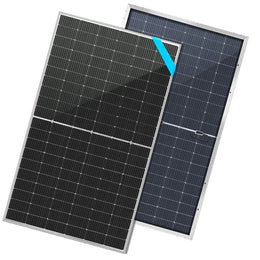
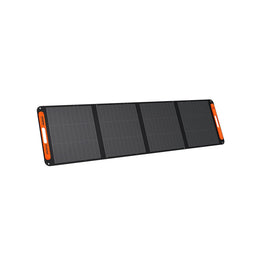
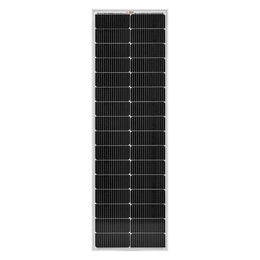
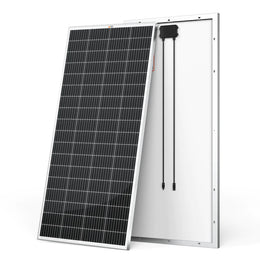

A commercial array is bought differently from a home kit. You are buying kilowatts by the pallet, the permit office wants a UL listing on every module, the racking crew cares about weight and dimensions, and the inverter sets how many panels fit in each string. A cheap panel that fails one of those checks costs more than it saves.
This guide compares seven large-format panels that are in stock today, from 335W TOPCon modules to 560W bifacial panels, with the math a business owner needs: system size from your utility bill, cost per watt at pallet prices, roof area, and string length for 500 V, 600 V and 1,000 V inverters. Everything here is also in our commercial solar PV panels collection.
Best commercial solar panels at a glance
| Panel | Best for | Watts | Cells | Module eff.* | Weight | Listing | Warranty | Largest pack | Price per watt |
|---|---|---|---|---|---|---|---|---|---|
| Sungold Power 440W N-Type (UL 61730) | Best overall value | 440 W | N-type TOPCon, 108 half-cut | 22.5% | 46.3 lb | UL 61730, CE, TUV, CEC | 30-yr linear power, 12-yr product | $3,942 / 20 pcs | $0.45/W |
| Sungold Power 560W Bifacial N-Type | Ground mounts and carports | 560 W | Bifacial N-type, 144 half-cut | 21.6% | 70.4 lb | CE, TUV (no UL listed) | 30-yr linear power, 12-yr product | $5,190 / 20 pcs | $0.46/W |
| Rich Solar MEGA 400W 24V | Large pallet orders | 400 W | Mono, 108 cells, 10-busbar | 20.5% | 45.2 lb | UL 61730, IEC 61215, CSA C22.2 | 25-yr power, 10-yr workmanship | $11,699 / 36 pcs | $0.81/W ($11,599 with ECO100) |
| Rich Solar MEGA 410W 24V (pallets) | UL + CSA mid-size pallets | 410 W | Mono, 108 cells, 10-busbar | 21.0% | 45.2 lb | UL 61730, IEC 61215, CSA C22.2 | 25-yr power, 10-yr workmanship | $3,799 / 12 pcs | $0.77/W ($0.75 with ECO100) |
| Sungold Power 450W Mono PERC | Budget UL-listed 48V arrays | 450 W | Mono PERC, 120 half-cut | 20.8% | 49.2 lb | UL 61730, CE, TUV, CEC | 25-yr output, 12-yr product | $4,395 / 20 pcs | $0.49/W |
| Rich Solar MEGA 335 PRO TOPCon (pallets) | Tight or hand-carried roofs | 335 W | N-type TOPCon, 96 cells | 21.6% | 35.2 lb | UL certificate on listing | 25-yr performance (80% at 25 yr) | $3,149 / 12 pcs | $0.78/W ($0.76 with ECO100) |
| Sungold Power 415W Mono PERC | Off-grid shops on a budget | 415 W | Mono PERC, 182 mm Grade A | 21.2% | 45.1 lb | Not stated on listing | 25-yr performance | $4,190 / 20 pcs | $0.50/W |
*Module efficiency is our calculation from rated watts and listed dimensions (watts / panel area / 1,000 W per m²), so every panel is measured the same way. Cell efficiency figures on some listings (23.2-25.1%) are higher because they ignore the frame and gaps between cells. Price per watt uses the largest pack on the listing; smaller packs cost more per watt.
What makes a panel commercial grade
There is no legal definition of a 'commercial' solar panel. In practice the phrase means a large-format, framed, rigid module built for fixed racking and a high-voltage string inverter, sold in volume. Five things separate a panel that suits a business install from one that only suits a camper:
- Size and wattage. Commercial projects use 400-600 W modules. The 108-cell format (about 68 x 45 in, roughly 45 lb) is the one a single installer can still carry up a ladder; 144-cell modules (about 90 x 45 in, 70 lb) give more watts per clamp but need two people and stronger rails.
- UL 61730 listing. The US safety standard for PV modules. Most building departments and utilities will not sign off a grid-tied system without it, and NEC 690.4 requires listed equipment. Canada asks for CSA C22.2 (or a UL/CSA dual listing).
- 1,500 V system rating. Every rigid panel in this guide is rated for a 1,500 V system, so the module never limits string voltage; the inverter and code do (600 V for one- and two-family dwellings, up to 1,000 V on most commercial buildings, 1,500 V in utility-scale plants).
- Mechanical loads. Look for a 5,400 Pa front (snow) and 2,400 Pa rear (wind) test rating if you build in snow country or on an exposed roof.
- Bankable warranty. 25 years is standard; N-type panels now carry 30-year linear power warranties. Workmanship (product) warranties of 10-12 years matter just as much on a commercial roof, because labor to swap modules is the expensive part.
Cell technology is the last choice. N-type TOPCon loses less output in heat and degrades more slowly than older PERC, which is why it carries the longer warranties. Bifacial modules add output from light reflected onto the rear glass - worth it on ground mounts, carports and white membrane roofs, worth very little flush on a dark roof. Our bifacial solar module and high watt solar panels collections group them by type.
How many panels does a business need
Start from the utility bill, not the roof. Take the average monthly kWh from the last 12 bills and use this formula:
Array kW = monthly kWh / (30 x peak sun hours x 0.80)
The 0.80 factor covers inverter, wiring, temperature and soiling losses. At 4.5 peak sun hours (a typical US average; the desert Southwest is 5.5-6.5, the Pacific Northwest and New England about 3.5-4) each kW of panels makes about 108 kWh a month. Panel count = array watts / panel watts, rounded up.
| Business type (example) | Monthly use (kWh) | Array size | 440W panels | 560W panels | Module area (440W) | Panels only at $0.45/W |
|---|---|---|---|---|---|---|
| Workshop or auto garage | 1,000 | 9.3 kW | 22 | 17 | 462 sq ft | $4,150 |
| Small office or retail shop | 2,500 | 23.1 kW | 53 | 42 | 1,114 sq ft | $10,370 |
| Farm with barns and pumps | 4,000 | 37.0 kW | 85 | 67 | 1,787 sq ft | $16,590 |
| Restaurant | 6,000 | 55.6 kW | 127 | 100 | 2,670 sq ft | $24,890 |
| Warehouse or light manufacturing | 10,000 | 92.6 kW | 211 | 166 | 4,436 sq ft | $41,480 |
Module area is the panels alone. Add 30-50% for row spacing on a flat roof (tilted rows must not shade each other in winter) and for fire-code setbacks from roof edges and ridges. The panel cost is only part of the project: inverters, racking, wiring, permits, engineering and labor usually bring an installed commercial system to several times the module price. Treat the last column as the module budget only.
Worked example: a farm using 4,000 kWh a month needs 4,000 / (30 x 4.5 x 0.8) = 37.0 kW. That is 85 Sungold 440W panels; buying four 20-packs plus a 6-pack gives 86 panels (37.8 kW) for 4 x $3,942 + $1,475 = $17,243, about $0.46 per watt for the modules. The same farm on a ground mount could use 67 of the 560W bifacial panels and pick up extra output from the rear side.
For a home-sized system the same method is explained in our what size solar system do I need guide, and the Solar Kit Calculator runs it for your ZIP code.
Cost per watt and roof space
Price per watt is the fair way to compare panels of different sizes. The Sungold packs scale from 2 to 20 panels and get much cheaper per watt as they grow: the 440W N-type runs $0.91/W in a 2-pack and $0.45/W in a 20-pack. The Rich Solar MEGA panels are sold only by the pallet (8, 10, 12 or 36), cost more per watt, and earn it with UL plus CSA listings, a 10-year workmanship warranty and the ECO100 code.
Roof space is the other limit. Watts per square foot is almost the same for all seven (19-21 W per sq ft), so on a crowded roof the bigger win is fewer modules: a 25 kW array is 45 of the 560W panels versus 75 of the 335W TOPCon modules, which means fewer clamps, rails and connectors to buy and install. Dead load is 2.1-2.5 lb per sq ft before racking - check it with the building's structural engineer, especially on older warehouse roofs.
String sizing for commercial inverters
Panels are wired in series strings, and open-circuit voltage (Voc) rises in cold weather. NEC 690.7 lets you correct with the manufacturer's temperature coefficient or, if you do not have it, a table factor: 1.14 for a record low of -6 to -10 °C (21-14 °F), 1.18 for -16 to -20 °C, 1.25 down to -40 °C. Maximum panels per string = inverter max DC voltage / (Voc x factor), rounded down.
| Panel | Voc (STC) | Cold Voc (x1.14) | Max per string, 500 V inverter | 600 V | 1,000 V |
|---|---|---|---|---|---|
| Sungold 440W N-Type | 39.03 V | 44.5 V | 11 | 13 | 22 |
| Sungold 560W bifacial | 50.09 V | 57.1 V | 8 | 10 | 17 |
| Sungold 450W PERC | 41.72 V | 47.6 V | 10 | 12 | 21 |
| Rich Solar MEGA 400 | 37.1 V | 42.3 V | 11 | 14 | 23 |
| Rich Solar MEGA 410 | 37.5 V | 42.7 V | 11 | 14 | 23 |
| Rich Solar MEGA 335 PRO | 36.9 V | 42.1 V | 11 | 14 | 23 |
The Sungold 415W listing does not publish Voc, so it is left out; ask us for the datasheet before designing strings. Also check the minimum MPPT voltage on hot days and the inverter's maximum input current per MPPT: the 560W panel's 14.09 A short-circuit current is fine for most modern inverters (16-25 A inputs) but too high for some older 12-13 A designs. For choosing the inverter itself, see our hybrid vs off-grid vs grid-tie inverter guide and the hybrid inverter collection.
7 commercial solar panels in stock now
All seven are active listings with stock on November 6, 2026 and ship free to the lower 48 states. Specs come from each listing's spec table; promo codes are mentioned only where the product is eligible.
Sungold Power 440W N-Type UL61730 - from $797 (2) to $3,942 (20)

The panel we would start most business quotes with. It is a 108-cell N-type TOPCon module in the carry-friendly 67.8 x 44.65 in format (46.3 lb) with UL 61730, CEC listing, 5,400 Pa snow and 2,400 Pa wind ratings and a 30-year linear power warranty plus 12 years on the product. Our calculated module efficiency is 22.5%, the highest of the seven. Packs run from 2 to 20 panels; the 20-pack is 8.8 kW for $3,942, about $0.45 per watt, and every pack is currently below its compare-at price. Voc of 39.03 V allows 13 panels per string on a 600 V inverter.
Sungold Power 560W Bifacial N-Type - from $980 (2) to $5,190 (20)

For a ground-mounted array beside a barn, a carport over a parking lot or raised racking over a white roof, this 144-cell bifacial module is the most watts per clamp in the store. Rated 560 W on the front with Sungold claiming up to 30% more from the rear glass in ideal conditions; 13.3 A Imp, 50.09 V Voc, 1,500 V system rating, 30-year linear power and 12-year product warranties. The 20-pack is 11.2 kW for $5,190 ($0.46/W) before any rear-side gain. The trade-offs: it is 89.8 x 44.7 in and 70.4 lb, so plan two-person handling, and the listing shows CE and TUV certification only - no UL 61730 - so confirm with your building department first. It is a strong fit for off-grid, agricultural and other installs where the AHJ accepts it. Pair it with our modular ground mount brackets ($185 per two panels).
Rich Solar MEGA 400W 24V - $2,599 (8) to $11,699 (36)

The MEGA 400 is the only panel here sold in a 36-panel pallet: 14.4 kW in one shipment for $11,699, or $11,599 with code ECO100 ($100 off orders of $1,500+). It is a 108-cell monocrystalline module with 10-busbar cells, 3.2 mm AR-coated glass, UL 61730, IEC 61215 and CSA C22.2 listings (useful if the project or the investor wants Canadian paperwork too), 5,400/2,400 Pa load ratings, a 25-year power and a 10-year workmanship warranty. At 45.2 lb and 67.8 x 44.7 in it handles like the 440W. It costs more per watt than the Sungold packs; you are paying for the listings, a single SKU for the whole roof and one delivery.
Rich Solar MEGA 410W 24V - $2,699 (8) to $3,799 (12)

Same frame, glass, certifications and warranty as the MEGA 400, with 10 W more per module and 8-, 10- or 12-panel pallets. The 12-pallet is 4.92 kW for $3,799 ($0.77/W), or $3,699 with ECO100 - the cheapest per watt of the Rich Solar options. Vmp 31.3 V and Voc 37.5 V suit 600 V string inverters (14 per string) and 24V or 48V MPPT charge controllers. A tidy choice for a shop roof, a farm outbuilding or a small office where the inspector wants UL and CSA marks on the label.
Sungold Power 450W Mono PERC - from $899 (2) to $4,395 (20)

If you want the UL 61730 listing at a lower entry price than the N-type, the 450W PERC panel is the value pick: 9 kW in the 20-pack for $4,395 ($0.49/W). It is a 120 half-cell module, 75.2 x 44.7 in and 49.2 lb, with a 1,500 V system rating, CEC listing, 12-year product warranty and an output guarantee of 95% at 5 years and 90% at 10 years within a 25-year performance warranty. PERC loses a little more in summer heat than N-type, which matters most in hot climates; in the north it performs close to the 440W.
Rich Solar MEGA 335 PRO TOPCon - $2,199 (8) to $3,149 (12)

The MEGA 335 PRO is the compact option: 69.3 x 34.7 in and 35.2 lb, so one person can carry it and it fits between rooftop units, along parapets and on narrow commercial roofs or trailers. Its 96-cell N-type TOPCon cells are rated up to 25.1% (about 21.6% as a module by our calculation), PID resistant, with 5,400/2,400 Pa ratings and a 25-year performance warranty that guarantees 80% at 25 years. Sold in pallets of 8, 10 or 12 in a silver frame or ONYX black; the 12-pallet is $3,149, or $3,049 with ECO100 ($0.76/W). The listing links its UL certificate.
Sungold Power 415W Mono PERC - from $875 (2) to $4,190 (20)

For an off-grid shop, ranch building or agricultural load that runs on a 48V inverter-charger, the 415W PERC panel is the module Sungold uses in its own off-grid kits. 21.25% efficiency, 67.9 x 44.7 in, 45.1 lb, IP68 junction box and a 25-year performance warranty; 8.3 kW in the 20-pack for $4,190 ($0.50/W). The listing does not show a UL listing or the Voc figure, so we recommend it for off-grid builds and suggest the 440W or 450W where an inspector will ask for UL 61730.
Want to compare more sizes? Browse 450W solar panels, 500W+ solar panels, 400W solar panels and the full rigid solar panel range.
Buying by the pallet, shipping and permits
- Pallet math. Buying the largest pack cuts the module cost roughly in half compared with 2-packs on the Sungold listings. Order a spare or two: matching panels of the same model and batch are hard to find years later, and a string should never mix models.
- Freight and receiving. Pallets ship by LTL freight. Make sure someone can receive them with a forklift or a liftgate truck, inspect for broken glass before signing, and store them flat and dry until installation.
- Permits and interconnection. A commercial grid-tied array needs stamped plans in most jurisdictions, a building and electrical permit, a structural review of the roof, and a utility interconnection agreement before switch-on. Systems over a certain size (often 25 kW or more) trigger extra utility studies.
- Rapid shutdown and fire access. NEC 690.12 requires roof arrays on buildings to de-energize for firefighters; the inverter or module-level electronics provide it, not the panel. Fire codes also set clear paths and setbacks on the roof.
- Incentives. The federal 25D credit for homeowners ended after December 31, 2025. Businesses use a different credit (Section 48E), but its rules changed in 2025 and 2026: projects that did not begin construction by July 4, 2026 face a tight placed-in-service deadline, and guidance is still evolving. Talk to a tax professional before counting on it. State and utility programs are listed in our solar rebates by state guide; the residential side is covered in our federal solar tax credit guide.
What buyers ask before buying commercial panels
These questions come from the searches that bring business buyers to our store and from Google's question results for commercial solar panels, answered with the specs of panels in stock.
What does 'commercial grade' mean when buying solar panels?
In practice: a large-format rigid module (400 W or more), UL 61730 listed, rated for a 1,500 V system, tested to 5,400 Pa snow and 2,400 Pa wind loads, with a 25-30 year power warranty and a 10-12 year product warranty. The Sungold 440W N-type and the Rich Solar MEGA 400/410 meet every point; the 560W bifacial lacks the UL listing and a published snow-load rating.
Is it cheaper to buy solar panels by the pallet?
Yes, usually by a wide margin. The Sungold 440W costs $398.50 per panel in a 2-pack and $197.10 per panel in a 20-pack. Rich Solar MEGA panels are pallet-only, and the ECO100 code takes another $100 off orders of $1,500 or more.
Are 72-cell or 144-cell panels better for commercial use?
Today's 144 half-cell modules are the successor of the old 72-cell format: about 90 x 45 in, 540-600 W, roughly 70 lb. They mean fewer panels and clamps per kW, so ground mounts and large flat roofs favor them. The 108-cell format (about 68 x 45 in, 400-450 W, 45 lb) is easier to handle on pitched roofs and smaller buildings.
What is the difference between commercial and residential solar panels?
Mostly size and paperwork, not the cells. The same 108-cell 400-450 W modules go on homes and small businesses; larger 144-cell modules, higher string voltages (up to 1,000 V on commercial buildings versus 600 V on homes) and stamped engineering are what make a project commercial.
Frequently asked questions
What are the best commercial solar panels in 2026?
For most small commercial and agricultural projects, the Sungold Power 440W N-Type panel is the best value: UL 61730 listed, a 30-year power warranty and about $0.45 per watt in the 20-panel pack. The Sungold 560W bifacial suits ground mounts and carports, and Rich Solar MEGA 400 and 410 pallets add CSA listing and a 10-year workmanship warranty.
How many solar panels does a business need?
Divide your average monthly kWh by 30, by your peak sun hours and by 0.8 to get array kW. A business using 2,500 kWh a month at 4.5 sun hours needs about 23 kW, which is 53 panels of 440 W or 42 panels of 560 W.
How much do commercial solar panels cost per watt?
In stock on November 6, 2026, large packs of UL-listed panels cost $0.45 to $0.81 per watt for the modules alone, from the Sungold 440W 20-pack to the Rich Solar MEGA 400 pallet. Installed commercial systems cost several times more once inverters, racking, engineering, permits and labor are included.
Are bifacial solar panels worth it for commercial projects?
Yes on ground mounts, carports and raised racking over white roofs or light gravel, where the rear glass can collect reflected light. Mounted flush on a dark roof, a bifacial panel performs like a regular one, so a cheaper monofacial UL-listed module is the better buy.
Do commercial solar panels need to be UL listed?
For grid-tied systems on buildings in the US, almost always: NEC 690.4 requires listed equipment and building departments look for UL 61730 on the module label. Off-grid and agricultural projects may have more flexibility, but check with your local authority before you buy.
Is there still a tax credit for commercial solar in 2026?
The homeowner credit (25D) ended after 2025, but businesses can still look at the Section 48E clean electricity investment credit. Its deadlines changed: projects that did not begin construction by July 4, 2026 face a placed-in-service deadline and new sourcing rules, so confirm eligibility with a tax professional.
Can I install commercial solar panels myself?
You can plan the array and, where local rules allow, do mechanical work, but a commercial system runs at 600-1,000 V DC and needs stamped plans, permits, inspection, a utility interconnection agreement and, in most jurisdictions, a licensed electrician or solar contractor.
More guides: best solar panels for mobile homes, best off-grid solar kits and whole-home battery backup cost.

Serhii Dovzhenko, Solar & Energy Storage Specialist at Eco Solar Kits · LinkedIn
Serhii is based in Vancouver, BC, and works on product data, system sizing and buyer guides for Eco Solar Kits. He attends solar and energy storage industry conferences and is involved in the community of electricians in Vancouver, BC. Credit for the data verification in this guide goes to Adsec.ca.