

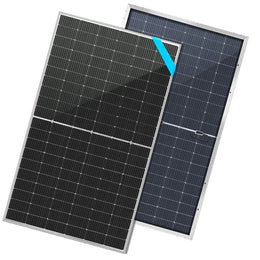
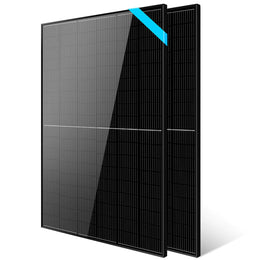
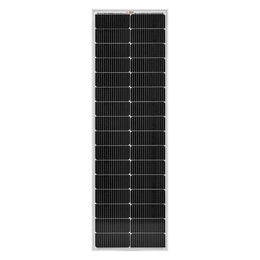
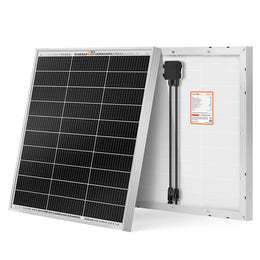


"What size solar panel do I need?" is the first question almost every 12V battery owner asks, whether the battery sits in a van, a boat, an ice-fishing sled or a backup box in the garage. The answer depends on three numbers: how much energy the battery holds, how much of it you use between charges, and how many hours of strong sun you get. This guide turns those numbers into panel watts, charge times and a controller size, then shows which in-stock panels and batteries fit each job.
If you are building a full 12V system with an inverter, our step-by-step guide to 12V solar panel kit setup covers the wiring and parts list. This page stays on one question: how much panel your battery needs.
The quick sizing rule for a 12V battery
Start with the battery's usable energy, then divide by what your panels actually deliver in a day.
- Battery energy: amp-hours x 12.8V for lithium (LiFePO4) or x 12V for lead-acid. A 100Ah lithium battery holds 1,280 Wh; a 200Ah holds 2,560 Wh.
- Energy to put back: how deep you discharge. A LiFePO4 battery used from 100% to 20% needs 1,024 Wh per 100Ah. A lead-acid (AGM, gel or flooded) battery should stop at about 50%, so it needs about 600 Wh per 100Ah plus around 15% charging loss.
- Real panel output: panel watts x peak sun hours x 0.75. The 0.75 covers heat, wiring, dust, angle and controller losses with an MPPT controller. Use about 0.6 with a PWM controller.
- Panel watts = energy to put back / (peak sun hours x 0.75).
Worked example: a 100Ah LiFePO4 battery used down to 20% in a place that gets 5 peak sun hours. 1,024 Wh / (5 x 0.75) = 273W, so a 300W array refills it in one day. With 200W it takes about a day and a half; with 100W, about three days.
Peak sun hours are not daylight hours. They are the hours of full-strength (1,000 W/m²) sun the day adds up to: roughly 5-6 in a southern US summer, 4-5 in spring and fall, and 2-3 in a northern winter. Look up your exact number for each month in NREL PVWatts.
Panel size by battery size: the table
Panel sizes below assume a LiFePO4 battery cycled from 100% to 20%, 5 peak sun hours, and an MPPT controller. For winter use at 2.5 sun hours, double the panel watts or accept twice the charge time.
| 12V battery | Energy to refill | Refill in 1 sunny day | Refill in 2 days | MPPT controller | Example array (in stock) |
|---|---|---|---|---|---|
| 50Ah lithium | 512 Wh | 150W | 100W | 10-15A | MEGA 150 or MEGA 100 Briefcase |
| 100Ah lithium | 1,024 Wh | 300W | 150-200W | 20-30A | MEGA 200 Briefcase + MEGA 100 |
| 100Ah AGM / flooded (to 50%) | ~700 Wh incl. losses | 200W | 100W | 20A | MEGA 200 12V |
| 200Ah lithium | 2,048 Wh | 550-600W | 300W | 40-50A | 2 x MEGA 250 12V (+ 1 x MEGA 100) |
| 300Ah lithium | 3,072 Wh | 800W | 400W | 60-70A | 3 x MEGA 250 + 1 x MEGA 50 |
| 400Ah lithium | 4,096 Wh | 1,100W | 550W | 80A+ (consider 24V) | 4 x MEGA 250 + 1 x MEGA 100 |
Above about 400Ah, a 12V bank needs very large controller currents and thick cables. That is the point where moving to 24V or 48V halves or quarters the current; our 12V vs 24V vs 48V guide walks through the switch.
A second way to size: cover your daily use instead of a full refill. A van with a 12V compressor fridge (about 400 Wh a day) plus lights, fans and phones (about 100 Wh) uses roughly 500 Wh. 500 / (5 x 0.75) = 133W in summer, so a 200W array leaves margin; in winter at 2.5 sun hours you need about 270W, so plan for 300W if you travel year-round.

Panel output falls with heat, low sun angles and dirt, which is why the sizing math uses 75% of the label watts.
How long it takes to charge: the math and two charts
The first chart shows how many peak sun hours each panel size needs to take a 12V LiFePO4 battery from 20% to full. Anything below the dashed line finishes within one good sunny day.

The second chart shows what each array puts into the battery per day by season. A 300W array just covers a full 100Ah lithium refill in spring and fall; in winter even 400W falls short, so either size up or plan for partial charges.

Three things make real charge times longer than the math:
- Loads running while charging. A fridge drawing 40W around the clock eats about 200 Wh of a 5-sun-hour day, so subtract daytime use before you count what reaches the battery.
- The last 5-10% (lead-acid). AGM and flooded batteries spend hours in absorption at reduced current. LiFePO4 accepts near-full current until it is almost full, which is why lithium recharges far faster from the same panel.
- Shade and angle. Partial shade on one cell string can cut a panel's output by a third or more. Flat-mounted roof panels in winter lose extra output because the sun is low; tilting portable panels toward the sun recovers much of it.
Charge controller: MPPT vs PWM and what size
Every panel over a few watts needs a charge controller between it and the battery. A 12V panel's open-circuit voltage is 20-23V (22.8V on the MEGA 100), far above the 14.4V a LiFePO4 battery should see.
| PWM controller | MPPT controller | |
|---|---|---|
| How it works | Connects the panel to the battery in pulses, pulling the panel down to battery voltage | Runs the panel at its best voltage and converts the extra volts into amps |
| Usable share of panel watts | About 60% in real use | About 75% in real use (95%+ controller efficiency) |
| Panels it can use | 12V-nominal panels in parallel only | 12V panels in series or parallel, or higher-voltage panels |
| Size by | Panel short-circuit current (Isc) x 1.25 | Array watts / 12 for the output amps; check max input voltage |
| Best for | Under 100-150W, maintainers, warm sunny climates | 200W and up, cold climates, long cable runs |
Sizing examples: a 200W 12V array with an MPPT controller produces about 200 / 12 = 17A, so a 20A controller fits. Two MEGA 250 panels (500W) produce about 42A, so use a 50A controller. With a PWM controller, add up the short-circuit current of panels wired in parallel and multiply by 1.25: two MEGA 200 panels (11.6A Isc each) need 2 x 11.6 x 1.25 = 29A, so a 30A PWM controller.
Wiring 12V panels in series raises voltage and cuts current, which lets you use thinner cable on long runs, but only with an MPPT controller. Check the cold open-circuit voltage: two MEGA 100s in series give 45.6V Voc at 77°F, roughly 55V on a freezing morning, so a 100V-input controller handles it easily. Our guide to solar panels in series vs parallel has the full voltage math.
Battery checks: lithium vs lead-acid, cold weather, charge rate
The panel is only half the equation. The battery's chemistry and limits decide how fast it can take that charge.
- Lithium (LiFePO4) vs lead-acid. A 100Ah LiFePO4 gives you about 80-100Ah of usable energy and accepts high current until nearly full. A 100Ah AGM gives about 50Ah before damage builds up and charges slowly at the top. Per usable amp-hour, lithium needs less panel and fewer sunny hours. The trade-offs are covered in our LiFePO4 vs lithium-ion vs AGM guide.
- Charge rate. Solar rarely stresses a LiFePO4 battery: 300W into a 100Ah battery is about 22A, or 0.22C. The ALPHA 1 LITE accepts up to 100A and the ALPHA 2 up to 100A, so small solar arrays never hit the limit. Large arrays on small banks can: 800W into a 100Ah battery is about 60A, which is fine for these batteries but worth checking on any battery with a 50A charge limit.
- Cold weather. LiFePO4 must not be charged below 32°F. Batteries without heaters, such as the ALPHA 1 LITE, simply stop accepting charge in the cold, so a winter van or cabin needs a self-heating battery. The Sungold 12V 200Ah turns its heater on below 33.8°F and off above 42.8°F, and the ALPHA 1 and ALPHA 2 also self-heat. For outage prep in the cold, see our winter power outage backup guide.
- Starter batteries. A car, boat or tractor starting battery only needs to be kept topped up against self-discharge and small parasitic loads. A 20-50W panel with a small controller is plenty; you are maintaining, not cycling.
Best panels and batteries for charging a 12V battery
All picks below were in stock on November 21, 2026. No discount codes apply to these items on their own: our codes and Black Friday automatic discounts start at $1,500 carts on eligible products. For a broader range, browse all 12V solar panels and 12V batteries.
RICH SOLAR MEGA 200 Watt 12V Briefcase Portable Solar Charging Kit

The simplest way to charge a 12V battery away from home: a folding 200W panel with a waterproof 20A charge controller built in, so you clip it to the battery and set it in the sun. At about 675 Wh on a 4.5-sun-hour day it puts back two-thirds of a drained 100Ah lithium battery, and a full refill from 50% on a good summer day. It folds to 33.1 x 26.4 in and weighs 26 lb, and you can aim it at the sun as it moves, which beats a flat roof panel in spring, fall and winter. Confirm the controller's battery setting matches your battery before the first charge.
$429.99 (list $469). 2-pack $849.98.
See price and stockRICH SOLAR MEGA 100W 12V Briefcase Portable Solar Panel

Half the size and about half the price, with a 10A built-in controller. At 338 Wh on a spring day it keeps a 50-100Ah battery topped up through light use (lights, a fan, phone charging) and is ideal for keeping a boat, trailer or RV house battery from going flat in storage. It folds to 25.2 x 18.1 in at 15.7 lb. Plan on three sunny days to refill a fully drained 100Ah lithium battery.
$229.99 (list $289).
See price and stockRICH SOLAR MEGA 250W 12V Monocrystalline Solar Panel

For a 200Ah lithium bank that cycles every day, two of these N-type TOPCon panels make 500W, about 1,700 Wh on a 4.5-sun-hour day, which nearly refills a 200Ah battery from 20% on a long summer day. Each is rated 18.9V Vmp and 13.7A Isc with a 25-year output warranty, IP68 junction box and 5,400 Pa snow load rating. Pair two with a 50A MPPT controller, or wire them in series to cut cable size on a long run.
$299.99 each (list $359). 2-pack $589.99.
See price and stockRich Solar MEGA 150W 12V Lightweight Monocrystalline Solar Panel

At 44.0 x 26.4 in and 18.1 lb, the MEGA 150 fits between roof fans and racks where a 200W panel will not. Two of them (300W) refill a 100Ah lithium battery in about one sunny day. N-type TOPCon cells rated 17.5V Vmp and 8.94A Isc, with a 25-year output and 10-year workmanship warranty.
$169 (list $199).
See price and stockRich Solar MEGA 100W FLEX 12V Flexible Monocrystalline Solar Panel

A 0.1-inch-thin, 4.8 lb panel that bends to follow curved roofs, bimini tops and boat decks. Rated 17.1V Vmp and 6.13A Isc, it gives about 340 Wh on a spring day. Flexible panels run hotter when glued flat to a roof, so expect slightly less output and a shorter life than framed glass; the warranty is 1 year on materials and workmanship.
$169 (list $195).
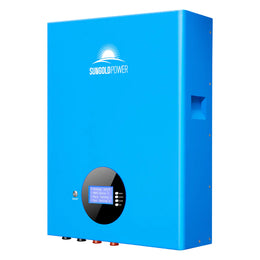
See price and stockSungold Power 12V 200Ah LiFePO4 Deep-Cycle Lithium Battery (Self-Heating, IP65)

If your 12V battery lives in an unheated van, cabin or garage, the battery matters as much as the panel. This 2,560 Wh LiFePO4 battery heats itself before charging below freezing, has a 200A BMS, Bluetooth monitoring, an IP65 case and a 5-year warranty, at one of the lowest prices per kWh among our 12V lithium batteries. Pair it with 550-600W of panels for a one-day refill, or 300W for two days.
$589. Also as a 2 x 100Ah pack ($590).
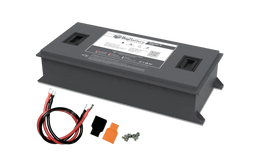
See price and stockRich Solar 12V 100Ah Lithium Battery | ALPHA 1 LITE

The ALPHA 1 LITE is the low-cost way to replace a lead-acid house battery with lithium: 1,280 Wh, 4,000+ cycles, 100A charge and discharge and 24.3 lb, roughly a third of a comparable AGM. It has no heater, so charging stops below 32°F; choose it for warm-climate or summer use and step up to the self-heating ALPHA 1 ($449) for winter charging. Pair it with 200-300W of solar.
$419.99 (list $449). 3-pack $1,099.
See price and stockWhat buyers ask before buying a panel for a 12V battery
These questions come from Search Console searches that already reach our store and from Google's question results for this topic. Answers use the specs of products we sell.
Is a 100W panel enough for a 12V 100Ah battery?
For topping up and light use, yes. For refilling it every day, no: 100W puts about 340 Wh into the battery on a spring day, a third of a full LiFePO4 refill. If you run a fridge, plan on 200-300W.
Can I use a 12V solar panel with charge controller for a lithium battery?
Yes, as long as the controller has a lithium (LiFePO4) profile or adjustable voltages. The MEGA 200 and MEGA 100 briefcase kits include controllers; for rigid panels like the MEGA 100 rigid ($109.99) or MEGA 100 SLIM ($129), add an MPPT controller sized with the formula above.
Should I buy a bigger panel or a bigger battery?
Size the battery for how long you need to run without sun (overnight or a cloudy weekend) and the panel for how fast you need to refill it. A big battery with a small panel never gets back to full; a big panel with a small battery wastes harvest once the battery is full by noon.
FAQ
What size solar panel do I need to charge a 12V 100Ah battery?
For a 12V 100Ah lithium (LiFePO4) battery, 200 to 300 watts of panels. 300W refills it from 20% in about one sunny day of 5 peak sun hours; 200W takes about a day and a half. For a 100Ah AGM or flooded battery, which you should only drain to about 50%, 200W covers one day's refill.
How long does a 100W solar panel take to charge a 12V battery?
About 13.7 peak sun hours to take a 12V 100Ah LiFePO4 battery from 20% to full with an MPPT controller, which is roughly 3 sunny days at 5 sun hours per day. From 50% it takes about 8.5 sun hours. A 100W panel is better at keeping a battery topped up than at refilling a deeply drained one.
Will a 50W solar panel charge a 12V battery?
Yes, slowly. A 50W panel puts roughly 190 Wh per sunny day into the battery, so it is a good maintainer for a car, boat or tractor starter battery and for a small 20-50Ah deep-cycle battery. It would need about 5 sunny days to refill a drained 100Ah lithium battery. Use a charge controller with it.
Can I connect a solar panel directly to a 12V battery?
Only a tiny trickle panel of a few watts with a built-in blocking diode. Anything larger needs a charge controller: a 12V panel's open-circuit voltage is about 20-23V, which will overcharge the battery, and lithium batteries need a controller with a LiFePO4 profile (about 14.2-14.6V charge, no equalization).
Can a solar panel overcharge a 12V battery?
Without a controller, yes. With a correctly set charge controller, no: the controller holds the battery at its absorption voltage, then drops to float or stops charging when it is full. Set the battery type in the controller (lithium, AGM, flooded) before connecting the panels.
Do I need a 12V solar panel to charge a 12V battery?
With a PWM controller, yes: use '12V nominal' panels with a Vmp around 17-19V. With an MPPT controller you can use higher-voltage panels or wire 12V panels in series, as long as the cold open-circuit voltage stays under the controller's maximum input voltage.
How many amps does a 100W solar panel put into a 12V battery?
About 5-6 amps in full sun. Rich Solar's MEGA 100 is rated 5.38A at 18.6V; a PWM controller passes roughly that current at battery voltage, while an MPPT controller converts the extra voltage into current, up to about 7 amps into a 13.3V lithium battery at full rated output and typically 5-6 amps in real sun.
For more panel sizing, read what a single 100-watt solar panel can run, or compare complete RV solar kits if you are outfitting a trailer.

Serhii Dovzhenko, Solar & Energy Storage Specialist at Eco Solar Kits · LinkedIn
Serhii is based in Vancouver, BC, and works on product data, system sizing and buyer guides for Eco Solar Kits. He attends solar and energy storage industry conferences and is involved in the community of electricians in Vancouver, BC. Credit for the data verification in this guide goes to Adsec.ca.


