

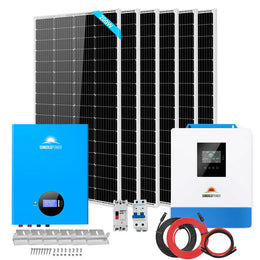
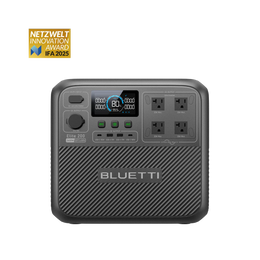
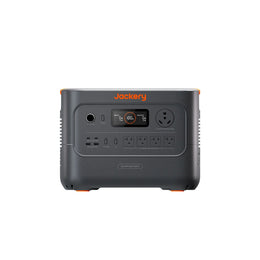
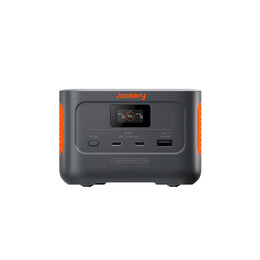
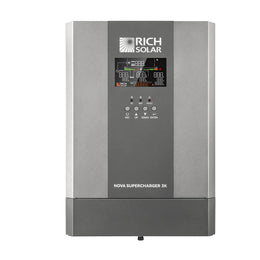

A 10,000 watt inverter is the size where a battery system stops being a critical-loads backup and starts running the whole house: central air, a well pump and the kitchen at the same time, on both 120V legs and 240V. It is also the size where the mistakes get expensive. Most problems we see are not with the inverter. They are a battery bank that cannot supply the current, or an order placed for 10,000 watts when the buyer needed 10,000 watt-hours.
This guide covers what a 10 kW inverter runs, the battery and wiring behind it, and seven in-stock models from $1,450 to $3,000, each with 120/240V split-phase output. If you are still choosing a size, start with what size inverter do I need. The full range is in our 10,000+ watt inverters collection.
What a 10,000 watt inverter can run
An inverter's rating is the load it can carry all day. Add the watts of everything that can run at the same time, then multiply by 1.25 so the inverter is not working at its limit. Here is a common whole-home list.
| Load | Running watts | Start-up | Voltage |
|---|---|---|---|
| Central air conditioner, 3 ton | 3,500 W | High - check locked-rotor amps | 240V |
| Well pump, 1 HP | 1,000 W | About 4,000 W | 240V |
| Refrigerator | 150 W | About 600 W | 120V |
| Microwave | 1,100 W | - | 120V |
| Washing machine | 500 W | About 1,200 W | 120V |
| Lights, TV, router, chargers | 600 W | - | 120V |
| Total running together | 6,850 W | ||
| With 25% headroom | 8,563 W | Fits a 10,000 W inverter |
That list fits with room to spare. Now add an electric dryer (about 5,000 W) while the air conditioner is running and the total is 11,850 W - over the limit. The answer is either to stagger the big 240V loads, which most households already do without thinking about it, or to step up to one of the 12 kW units below.
Two more limits matter. Surge: a motor pulls several times its running watts for a second or two when it starts, so the inverter's surge rating must cover the biggest motor on top of whatever else is running. And legs: a split-phase inverter delivers half its rating on each 120V leg, so a 10 kW unit gives about 5,000 W (41.7 A) per leg. A panel with all the heavy 120V circuits on one side can overload a leg while the inverter as a whole is half idle. Split-phase inverters explained explains leg balancing in detail.
10,000 watts is not 10,000 watt-hours
Search data shows the two get mixed up constantly. Watts (W, kW) are power: how much the inverter can deliver at one moment. Watt-hours (Wh, kWh) are energy: how much the battery stores. A 10,000 W inverter says nothing about how long the house runs; that depends on the battery behind it.
The average US home uses about 29 kWh a day, an average draw near 1.2 kW. On a 16 kWh battery that is 16 x 0.85 / 1.2 = about 11 hours with no solar. The same inverter on a 5 kWh battery gives under four hours. If you came here looking for a 10,000 Wh battery or power station, how many batteries do I need for solar is the right guide; if you want the full system priced, see 10 kW solar system cost with battery.
The battery a 10 kW inverter needs
This is the part that decides whether a 10 kW inverter works. Every model here runs on a 48V lithium bank, and the current on the battery side is large:
Battery amps = inverter watts / 51.2 V / 0.92 (0.92 covers inverter losses). At 10,000 W that is about 212 A.

One 100 A battery covers about 4.7 kW. A 10 kW inverter at full load needs more than 200 A.
| Battery type | Continuous current each | Units for 10 kW (212 A) | Units for 12 kW (255 A) |
|---|---|---|---|
| 48V 100Ah rack or wall module (5.12 kWh) | 100 A | 3 (15.4 kWh) | 3 (15.4 kWh) |
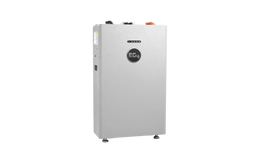
| Cabinet battery, 314Ah class (about 16 kWh) | 150 A | 2 (about 32 kWh) | 2 (about 32 kWh) |
| Wall battery rated 200 A (about 16 kWh) | 200 A | 1 at its limit, 2 for margin | 2 (about 32 kWh) |
You can run a 10 kW inverter on a smaller bank. It will simply never deliver 10 kW: a single 100 A module holds the system to about 4.7 kW, and a heavy start-up will trip the battery's protection before the inverter complains. Check charge current too. These inverters can push 120 to 240 A into the bank from solar or a generator, and each battery has its own charge limit. Sizing by energy is covered in the battery guide linked above; compare formats in our lithium batteries collection.
240V output, breakers and wire size
All seven picks put out 120/240V split-phase power, the same service a US home gets from the utility, so they can feed a standard breaker panel.
| Side | 10,000 W | 12,000 W | Typical hardware |
|---|---|---|---|
| AC output at 240V | 41.7 A | 50 A | - |
| x 1.25 for continuous load | 52 A | 62.5 A | 60 A / 70 A two-pole breaker; 6 AWG / 4 AWG copper |
| Per 120V leg | 5,000 W | 6,000 W | Balance heavy 120V circuits across both legs |
| Battery side at 48V | 212 A | 255 A | 4/0 cable; 250 to 300 A fuse or breaker |

Breakers and conductors on both the AC and battery side are sized from the inverter's current, not its price.
How much solar a 10 kW inverter takes
Solar input is a separate rating from AC output. Three numbers matter: maximum PV watts, maximum open-circuit voltage (Voc) and the amps each tracker accepts. Worked example for the APEX-10K with 440 W panels (Vmp 33.48 V, Voc 39.03 V, Imp 13.15 A):
- Cold-weather Voc = 39.03 x 1.14 = 44.5 V per panel, so 12 panels reach 534 V - inside the 550 V limit.
- Each tracker takes 22 A, so one string per tracker (two in parallel would be 26.3 A).
- Tracker 1 (5,000 W): 11 panels = 4,840 W. Tracker 2 (5,500 W): 12 panels = 5,280 W.
- Total: 23 panels, 10.12 kW, about 35 kWh on a 4.5 sun-hour day (kW x sun hours x 0.77).
That layout is our calculation, not a wiring diagram; confirm it against the manual and your record low temperature. On the 500 V Sungold inputs the same panel tops out at 11 per string. String math is explained step by step in solar panels in series vs parallel.
Seven 10,000-watt-class inverters compared
Prices and stock were checked on November 15, 2026. Codes shown are the ones each product is eligible for today; codes do not stack. A dash means the listing does not state the figure.
| Inverter | Price (best code) | Continuous | Surge | Solar input | Max PV voltage | Grid export | Enclosure | Warranty |
|---|---|---|---|---|---|---|---|---|
| BigBattery APEX-10K | $1,680 (no code) | 10,000 W | 20,000 VA | 10,500 W, 2 MPPT | 550 V | No | IP20 indoor | - |
| Sungold FR12K-B | $1,611 (no code) | 12,000 W | 24,000 W | 13,200 W, 2 MPPT | 500 V | No | IP20 indoor | 2 years |
| Sungold 10,000W split phase | $1,530 with ECO50 ($1,580) | 10,000 W | - | 11,000 W, 2 MPPT* | 500 V* | No | - | - |
| Sungold 2 x 5,000W parallel set | $1,450 with ECO50 ($1,500) | 10,000 W (2 x 5,000 W) | - | 100 A MPPT per unit | - | No | - | - |
| Sungold SGN-11K15PRO | $3,000 with ECO100 ($3,100) | 11.4 kW listed | - | 15,000 W, 3 MPPT | 600 V | Yes (hybrid) | IP65 / NEMA 3R | - |
| Sungold SGS-12K18MAX | $2,691 (no code) | 12,000 W | 18,000 W for 10 s | 18,000 W, 2 MPPT | 550 V | Yes, UL 1741 SB | IP65 | 10 years |
| Sungold 12,000W inverter charger | $2,799 with ECO100 ($2,899) | 12,000 W | 36,000 W for 20 s | None - separate controller | - | No | - | - |
* The standalone listing is short; these figures come from the Sungold kit listings that ship the 10,000 W split-phase unit. Confirm on the manual before designing strings.

Off-grid units cost $134 to $168 per kW. Grid-interactive hybrids and the low-frequency charger cost more for reasons other than watts.
The seven picks in detail
1. BigBattery APEX-10K

$1,680 (list $1,830) - 10,000 W, 20,000 VA surge, no code today
The APEX-10K is the cleanest match for the search: exactly 10 kW continuous at 120/240V with double that in surge and a 6 HP motor rating. Two MPPT trackers take 5,000 W and 5,500 W at up to 550 V, solar charging reaches 200 A and a grid or generator input adds 120 A. It passes 80 A through to loads, switches in about 10 ms and parallels up to six units. It is an indoor IP20 unit weighing 62 lb, with UL 1741 on the listing and closed-loop communication with BigBattery NEXUS, ETHOS and HUSKY 2 and EG4 280Ah and 314Ah batteries.
- Full spec sheet: surge, PV, charge and pass-through all stated
- 550 V PV input fits 12 x 440 W panels per string
- Breakers for utility, load, battery and PV are built in
- One AC input: grid or generator, not both at once
- Off-grid design, no export to the utility
- Warranty term is not on the listing - ask us
2. Sungold Power FR12K-B

$1,611 (list $1,790) - 12,000 W, 24,000 W peak, no code today
For $69 less than the APEX-10K the FR12K-B gives 2,000 W more output: $134 per kW, the lowest here. Two 22 A trackers take 6,600 W each at up to 500 V (MPPT 125 to 425 V), with 200 A of charging. It has a PV rapid shutdown initiator and input and output breakers built in, which saves parts on a permitted roof array, and its generator port can become a smart-load output that sheds non-critical circuits when the battery is low. Indoor IP20, 61.73 lb, UL 1741, up to six in parallel.
- Lowest price per kW and 2 kW of headroom over a 10 kW unit
- Built-in rapid shutdown and breakers
- Smart-load port for automatic load shedding
- 2-year warranty
- 500 V limit: 11 x 440 W panels per string
- Off-grid only; needs about 255 A of battery at full load
3. Sungold Power 10,000W 48V Split Phase Solar Inverter

$1,580, or $1,530 with code ECO50
A single-box 10,000 W split-phase inverter with solar charging and Wi-Fi monitoring for off-grid and backup systems with 240V loads. The store listing is brief. The Sungold kits that ship this 10,000 W unit list two trackers, 11,000 W of PV, 125 to 425 V MPPT range, 500 V maximum and 200 A of charging with ETL-listed UL 1741; check those against the manual linked on the product page before you design the array.
- Lowest price for one 10 kW split-phase box
- ECO50 applies
- The 10,000 W unit Sungold builds its 10 kW PowerMax kit around
- Short listing: surge, enclosure and warranty are not stated
- Off-grid only
- For $31 more the FR12K-B is fully specified and 12 kW
4. Sungold Power 10,000W Solar Charger Inverter (2 Units Parallel)

$1,500, or $1,450 with code ECO50
Two 5,000 W pure sine inverters sold as a set and wired together for 10,000 W. Each has a 100 A MPPT solar charger and a 40 A battery charger, and the set is ETL listed to UL 1741. In the Sungold kit built on this pair, each unit is a 120V inverter and 240V comes from running the two as split phase, so treat it as 5,000 W per leg and confirm the wiring mode on the spec sheet. The practical upside is that one unit can keep a 120V leg alive if the other is down.
- Lowest price here for 10,000 W
- Two independent solar chargers
- A fault in one unit does not take out everything
- Both units must be configured as a pair before first power-up
- Listing gives no PV voltage window or surge figure
- More wiring and wall space than one box
5. Sungold Power SGN-11K15PRO

$3,100, or $3,000 with code ECO100
The first of two picks that can work with the utility as well as without it. The listing gives 11.4 kW of output; a Sungold kit listing for the same inverter describes 10 kW continuous with an 11.4 kW peak, so plan around 10 kW. Three trackers take 15,000 W of PV at up to 600 V (70 to 540 V range), there are two 200 A load breakers and a 300 A battery breaker inside, and the IP65 / NEMA 3R case can go on an outside wall. Up to nine units parallel.
- 200 A whole-home backup without a critical-loads panel
- 600 V input: 13 x 440 W panels per string
- Outdoor-rated enclosure
- Surge rating, weight and warranty are not on the listing
- Costs about twice an off-grid 10 kW unit
- Utility approval is needed before exporting
6. Sungold Power SGS-12K18MAX

$2,691 (list $2,990) - 12,000 W, 18 kW of PV, no code today
The better-documented hybrid and the cheaper one. It delivers 12,000 W at 240V with 1.5 times that for 10 seconds, takes 18 kW of solar on two 32 A trackers at up to 550 V, and passes 200 A through from the grid so it can sit ahead of a 200 A main panel. It is UL 1741 SB and IEEE 1547-2018 listed for grid export, supports AC coupling with an existing grid-tie array, and forms a UL 9540 system with Sungold's PowerMax battery. IP65, 105.82 lb, rated from -13F to 140F, 10-year warranty.
- UL 1741 SB: the listing most rebate and net-metering programs ask for
- 32 A trackers accept two parallel strings of 440 W panels
- 10-year warranty
- No discount code applies today
- Heavier and larger than the off-grid units
- Surge is 1.5x, lower than the off-grid models
7. Sungold Power 12,000W Split Phase Inverter Charger

$2,899, or $2,799 with code ECO100
A low-frequency, transformer-based inverter charger: 12 kW continuous and 36 kW of surge for 20 seconds, three times its rating, which is what deep well pumps, compressors and shop tools want. It has a 120 A charger, automatic generator start, a remote and a battery temperature sensor in the box, and transfers in about 10 ms. It needs a 240V AC input and has no solar input, so panels go through a separate MPPT charge controller. At 160 lb it is a two-person lift.
- 36 kW surge for 20 s, the highest here
- Auto generator start included
- Simple, proven design for generator-backed sites
- No built-in solar charging
- Idle draw of 180 W with power saver off (40 W with it on)
- 160 lb; AC input must be 240V
Which one fits your setup
| Your situation | Pick | Why |
|---|---|---|
| Off-grid home or cabin, 10 kW is enough | APEX-10K | Exact 10 kW, strong surge, 550 V solar input |
| Off-grid, want headroom or a permitted roof array | FR12K-B | 12 kW, rapid shutdown and breakers built in |
| Tightest budget | 2 x 5,000W set or Sungold 10,000W | $1,450 to $1,530 with ECO50 |
| Grid-tied home, want backup and export | SGS-12K18MAX | UL 1741 SB, 200 A pass-through, 10-year warranty |
| Large array on three roof faces | SGN-11K15PRO | Three trackers, 600 V |
| Big motors, generator on site | 12,000W inverter charger | 36 kW surge, auto generator start |
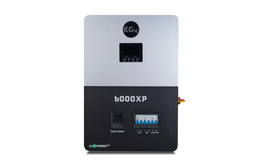
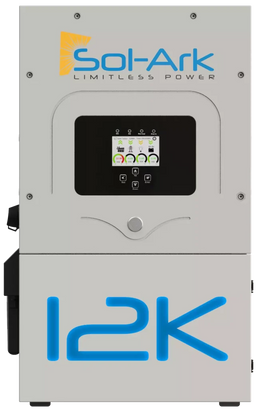
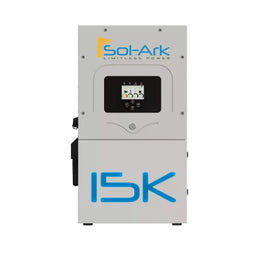
Not sure whether you need a hybrid at all? Hybrid vs off-grid vs grid-tie inverters compares the three types. EG4 and Sol-Ark units in this power class are covered in EG4 vs Sol-Ark, and Sungold's complete kits built around these inverters are mapped in Sungold Power kits explained. More models are in our Sungold Power inverters and split-phase inverters collections.
What buyers ask before ordering a 10,000 watt inverter
These come from the searches that bring people to our inverter pages and from the questions Google shows for this topic.
Does a 10,000 watt inverter give 240V?
Every model in this guide does: 120/240V split phase, with about half the rating available on each 120V leg. That is not true of all 10 kW inverters sold online. Some are 120V only and some are 230V single-phase units built for other countries, which cannot feed a US panel without a transformer. Check for the words split phase and 120/240V.
What does a 10,000 watt inverter cost?
Here, $1,450 to $1,680 for off-grid models and $2,691 to $3,000 for grid-interactive hybrids. Budget the battery separately: a bank that can feed 10 kW usually costs more than the inverter. Whole-home battery backup cost shows how the totals compare with an installed system.
Can I get a 10,000 watt inverter for 12 volts?
Not sensibly. At 12.8 V, 10,000 W is close to 870 amps, which needs several paralleled cables as thick as a thumb and a bank of eight or more large batteries. That is why every 10 kW inverter we carry is 48V, where the same power is about 212 A.
Can I buy a 10 kW inverter with the battery included?
Yes. Sungold's complete kits pair these inverters with rack, wall or cabinet batteries and panels; the kits guide linked above lists them with prices. Buying together also removes the most common mistake, a battery that cannot supply the inverter's current.
FAQ
What will a 10,000 watt inverter run?
A 10,000 watt 120/240V inverter runs a typical house load together: a 3-ton central air conditioner (about 3,500 W), a 1 HP well pump, a refrigerator, a microwave, a washer, lights and electronics add up to about 6,850 W, which leaves the 25% headroom we plan for. It will not carry that list plus an electric dryer or water heater at the same moment, so those loads are staggered or the inverter is sized up to 12 kW.
How many batteries do I need for a 10,000 watt inverter?
At full output a 10,000 W inverter draws about 212 amps from a 48V lithium bank (10,000 / 51.2 V / 0.92). That takes three 100 A server rack batteries, two 150 A cabinet batteries or one 200 A wall battery running at its limit. Fewer batteries still work for lighter loads, but the bank will trip its protection if the house asks for the full 10 kW.
Can a 10,000 watt inverter run central air conditioning?
Usually yes for a 3 to 4 ton unit. Running draw is about 3,500 to 5,000 W; the start-up surge is the hard part. Compare the compressor's locked-rotor amps with the inverter's surge rating, make sure the battery bank can deliver that current, and add a soft starter if the compressor is older or larger.
What size breaker and wire does a 10,000 watt inverter need at 240V?
10,000 W at 240 V is 41.7 amps. With the usual 125% factor for continuous loads that is 52 A, so the AC output normally lands on a 60 A two-pole breaker with 6 AWG copper. The 48V battery side carries about 212 A, which typically means 4/0 cable and a 250 to 300 A fuse or breaker. Your electrician and the inverter manual set the final sizes.
Is a 10 kW inverter enough for a whole house?
For most gas-heated homes, yes. The average US home uses about 29 kWh a day, which is an average draw near 1.2 kW, and peaks of 6 to 8 kW are common. All-electric homes with a heat pump, electric range, dryer and water heater can peak above 12 kW and need a larger inverter, two units in parallel, or load management.
How many solar panels can a 10,000 watt inverter take?
It depends on the inverter's solar input, not its AC rating. The APEX-10K takes 10,500 W on two trackers, which is 23 x 440 W panels in two strings by our calculation. The Sungold FR12K-B takes 13,200 W, the SGN-11K15PRO 15,000 W and the SGS-12K18MAX 18,000 W. The Sungold 12,000 W inverter charger has no solar input and needs a separate charge controller.

Serhii Dovzhenko, Solar & Energy Storage Specialist at Eco Solar Kits · LinkedIn
Serhii is based in Vancouver, BC, and works on product data, system sizing and buyer guides for Eco Solar Kits. He attends solar and energy storage industry conferences and is involved in the community of electricians in Vancouver, BC. Credit for the data verification in this guide goes to Adsec.ca.


