

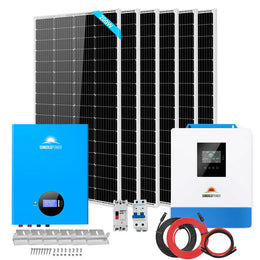
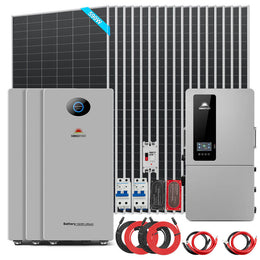

It surprises many new solar owners: a storm knocks out the power, the sun comes out, and the house stays dark. Nothing is broken - a grid-tie system is designed to do exactly that. The panels still make DC electricity, but the inverter is required to switch off the moment the utility grid disappears.
This guide explains why that happens, the five realistic ways to keep the lights on (from a daytime-only outlet to whole-home battery backup), how to size the battery and inverter for your outage loads, and which outage-ready products are active and in stock on our store as of November 25, 2026. If you already own a grid-tie system and want the step-by-step retrofit (AC vs DC coupling, wiring layouts), our guide to adding a battery to an existing solar system covers that in detail; this article focuses on what happens during the outage itself and what to buy.
Why grid-tie solar shuts off in a power outage
A grid-tie inverter is not a power source on its own. It synchronizes to the utility's voltage and frequency and pushes solar power into that waveform. When the grid fails, three things make it stop:
- Anti-islanding protection. Inverters sold for grid connection in the US are certified to UL 1741 and the IEEE 1547 interconnection standard, which require them to detect a grid outage and stop exporting within about 2 seconds. The goal is to stop a home from "islanding" - energizing lines crews believe are dead.
- Lineworker safety. Your inverter's output passes through the service transformer, which steps it back up to thousands of volts on the street. A repair crew working on a downed line could be injured by backfeed from a house that keeps exporting.
- No reference to follow. Even ignoring the rules, a plain grid-tie inverter has no battery to absorb the difference between what the panels make and what the house uses. Solar output changes second by second with clouds, so without a buffer it could not hold a stable voltage for your appliances.
Rapid shutdown (NEC 690.12) is a separate feature that de-energizes roof wiring for firefighters; it is not what turns your power off in an outage, but it means the panels go quiet too. Net metering doesn't help either: credits on your bill are worth nothing while the grid is down.

Storm damage to distribution lines is the most common cause of residential outages - and exactly when anti-islanding switches a grid-tie array off.
5 ways to keep power when the grid goes down
There is no single fix. The right option depends on whether you already have solar, how long your outages last, and whether you need 240V loads such as a well pump. Here is how the five routes compare.
| Option | Rooftop panels keep working? | Power at night? | Typical equipment cost | Best for |
|---|---|---|---|---|
| 1. Daytime-only outlet (some grid-tie inverters, e.g. SMA Secure Power Supply, Enphase IQ8 "Sunlight Backup") | Partly - sunny hours only | No | $0-$1,500 if your inverter supports it | Charging phones, running a fridge a few hours a day |
| 2. Add an AC-coupled battery to your existing grid-tie system | Yes | Yes | $4,500-$9,000 (hybrid inverter + 10-16 kWh) | Homes with newer grid-tie solar that works well |
| 3. Replace the grid-tie inverter with a hybrid inverter + battery (DC-coupled) | Yes | Yes | $5,000-$11,000 equipment | New systems, or old string inverters near end of life |
| 4. Power station or portable kit + transfer switch / smart panel | No (portable panels only) | Yes | $2,000-$5,000 | Renters, no roof solar yet, essential circuits only |
| 5. Fuel generator | No | Yes, while fuel lasts | $1,000-$15,000 + fuel | Week-long outages, very large loads |
Option 1 is worth checking first because it costs little: some SMA Sunny Boy US inverters have a dedicated outlet that delivers up to about 2,000W when the sun is out, and Enphase IQ8 systems can run selected loads in daylight with additional control hardware. But output collapses when a cloud passes, there is nothing at night, and most inverters have no such mode.
Options 2 and 3 are what most people mean by "solar that works in a power outage." A battery-based (hybrid) inverter disconnects the house from the grid, forms its own stable 60 Hz grid, and lets the panels keep producing. The difference is wiring: AC coupling keeps your existing grid-tie inverter and adds a hybrid inverter and battery beside it; DC coupling sends the panels straight into the hybrid inverter. Our hybrid vs off-grid vs grid-tie inverter guide explains the three inverter families.
Option 4 leaves your grid-tie array off during the outage but gives you battery power through an inlet box, interlock or smart panel; the guide to connecting a power station to your house walks through each method. Option 5 is the fallback for very long outages; many hybrid inverters below also accept a generator input to recharge the battery.
How a solar + battery system keeps running in an outage
When a hybrid inverter senses the grid voltage drop, it opens an internal or external transfer relay, isolating the home from the utility, then supplies the backed-up circuits from the battery. The listed transfer times are short: the Sungold SGS-12K18MAX switches in about 10 ms, and the EG4 FlexBOSS21 in 20 ms by default (10 ms configurable). Most computers, Wi-Fi routers and clocks ride through that without rebooting.
From there, the inverter balances three flows:
- Solar more than load: the surplus charges the battery. In an AC-coupled system, once the battery is full the hybrid inverter shifts its frequency slightly, which tells the existing grid-tie inverter to throttle back. That is why AC coupling only works with hybrid inverters that support it and grid-tie inverters set up for frequency-watt response.
- Load more than solar: the battery covers the gap, up to the inverter's battery-only power limit.
- Grid returns: the inverter waits for stable voltage and frequency, reconnects, and goes back to normal grid-tie operation, including exporting under your net metering agreement.
Whole-home vs critical loads. Inverters with a 200A pass-through (the Sungold SGS-12K18MAX, for example) can sit between the meter and the main panel and back up the entire house. Models with a smaller pass-through, such as the 80A on the EG4 12kPV or 90A on the FlexBOSS21, usually feed a separate critical-loads sub-panel with the circuits you choose: fridge, freezer, furnace blower, lights, outlets, Wi-Fi and the well pump if it fits.
Outage sizing math: battery kWh, inverter kW and solar refill
Size three numbers separately: the battery (how long), the inverter (how much at once) and the solar array (how fast it refills).
1. Battery: how many hours do you need?
Add the average power of your outage loads. A practical essentials list - refrigerator, chest freezer, LED lights, internet, a gas furnace blower and phone charging - averages about 0.4-0.6 kW around the clock, or 10-14 kWh a day. Add a well pump, an induction burner and a mini-split and the average climbs to roughly 1.5 kW, about 36 kWh a day. Then:
Runtime (hours) = battery kWh × 0.9 ÷ average load (kW)
Example: one 16.07 kWh Sungold PowerMax at a 0.5 kW essentials load gives 16.07 × 0.9 ÷ 0.5 ≈ 29 hours with no sun at all. At 1.5 kW it drops to about 9.6 hours.
For how long specific battery sizes run a whole house, see how long a 5, 10 or 15 kWh battery runs a house.
2. Inverter: how much power at once?
During an outage at night, the limit is the inverter's battery-only output, which is often lower than the headline number. Check it on the spec sheet: the FlexBOSS21 system listing rates 16 kW with PV and grid combined but 6 kW from a single battery alone; one PowerMax 16.07 kWh battery is rated at 7.68 kW of DC power. Add up the loads that can run together and leave room for motor starts: a 1 HP 240V well pump can draw 3-5 times its running watts for a fraction of a second, so look at peak or surge ratings too (the EG4 12kPV lists 16,000W for 0.5 s).
3. Solar: can the array refill the battery every day?
This is where a solar + battery system beats a stand-alone battery in a multi-day outage. Daily refill ≈ array kW × peak sun hours × 0.8. An 8 kW array refills about 12.8 kWh on a dark winter day and about 25.6 kWh in spring or fall - enough to cover essentials indefinitely, as long as the battery can absorb it.
Best outage-ready inverters, batteries and kits in stock
All six picks were active and in stock on November 25, 2026. Prices are the store prices on that day; Black Friday tier discounts apply automatically at checkout through December 1 where noted, and promo codes don't stack with them.
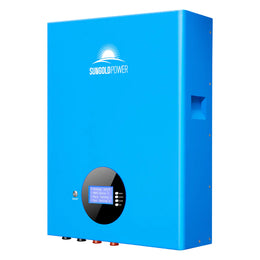
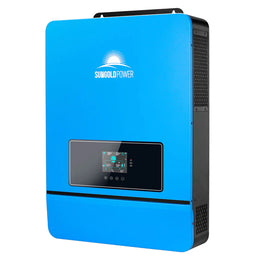
1. Sungold Power SGS-12K18MAX 12kW Hybrid Inverter + PowerMax 16.07 kWh Battery

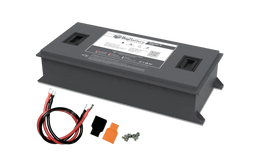
The most direct answer to "keep my whole house on when the grid fails." The SGS-12K18MAX has a 200A continuous pass-through, so it can be installed between the meter and a 200A main panel and back up every circuit, switching to battery in about 10 ms. It takes 18 kW of solar, is UL 1741 SB listed, and supports AC coupling with an existing grid-tied inverter. Paired with the PowerMax 16.07 kWh outdoor battery (IP65, 8,000 cycles) it forms a UL 9540 certified system, which simplifies permitting.
Price checked Nov 25, 2026: inverter $2,691 (compare at $2,960) + PowerMax $2,696 (compare at $2,966) = $5,387. Prefer a complete package? The SGS12K kit with 20 x 450W panels and the PowerMax is $9,248 ($9,098 with the automatic Black Friday $150 off).
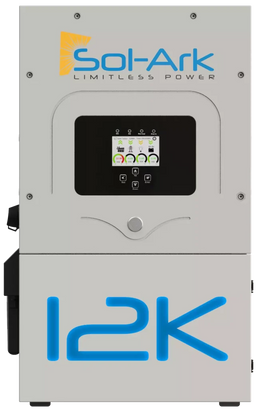
See the SGS-12K18MAX2. Sol-Ark 15K All-In-One Pre-Wired Hybrid Inverter

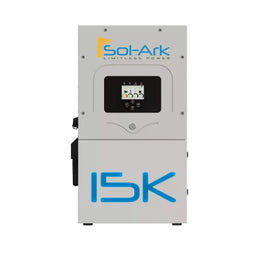
An installer favorite for adding outage protection to a home that already has grid-tie solar. The listing highlights AC coupling for retrofits, 15 kW rated AC output, 18 kW of solar input, 98% efficiency, generator input and parallel capability (UL 1741 SA). It comes pre-wired, which shortens install time.
Price checked Nov 25, 2026: $5,650 (compare at $7,359); $5,250 with the automatic Black Friday $400 off orders of $4,000+ through Dec 1. See all Sol-Ark inverters.
See the Sol-Ark 15K3. EG4 FlexBOSS21 + WallMount 16 kWh Indoor Battery Grid-Tied ESS

A pre-matched, UL 9540-eligible inverter and battery pair sold as one item. The FlexBOSS21 accepts up to 21 kW of solar across 3 MPPTs (handy for multi-orientation roofs) and delivers up to 16 kW with PV and grid combined. Be clear on the outage number: from the battery alone the listing rates 6 kW continuous with this single 16 kWh battery (12.86 kWh recommended usable), with 20 ms default transfer and a 90A grid pass-through, so plan it around a critical-loads panel.
Price checked Nov 25, 2026: $7,339.98 (compare at $7,659); 2 batteries $11,274.96; 3 batteries $15,209.94. More options in EG4 inverters.
See the FlexBOSS21 system4. EG4 12kPV 8,000W 48V Hybrid Inverter, All-Weather

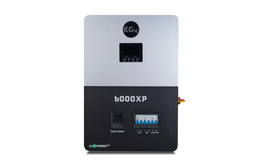
For essentials backup rather than every circuit, the 12kPV hits a sensible middle: 8,000W continuous with 16,000W peak for 0.5 s (good for well pump and AC compressor starts), 12 kW of solar on two MPPTs, and a NEMA 4X enclosure so it can hang outside. It runs grid-tied with AC coupling for retrofits or fully off-grid.
Price checked Nov 25, 2026: $2,999.99 (compare at $3,169). Pair it with a battery from our solar battery storage collection.
See the EG4 12kPV5. Fortress Power eFlex Max 5.4 kWh 48V LFP Battery

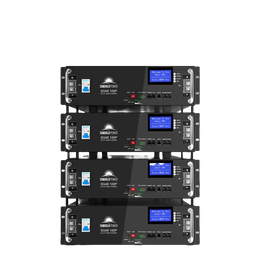
To start small and add capacity over time, the eFlex Max is a rugged 5.374 kWh module: automotive-grade LiFePO4 cells, 8,000 cycles at 80% depth of discharge, IP65 for outdoor installs and wall, floor or rack mounting, with closed-loop communication. Two or three modules cover the 10-16 kWh range most essentials-backup homes need.
Price checked Nov 25, 2026: $1,789 (compare at $2,199); $1,639 with the automatic Black Friday $150 off orders of $1,500+ through Dec 1.
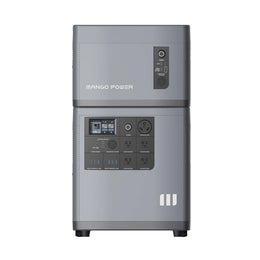
See the eFlex Max 5.46. Mango Power E 6,000W 7,060Wh 240V Home Backup Kit with mPanel Pro

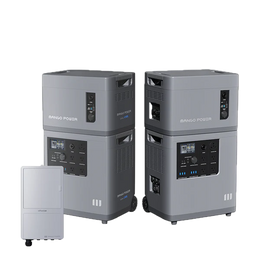
Not ready to rework your grid-tie system? Two Mango Power E stations plus the electrician-installed mPanel Pro smart panel switch your essential circuits to 6,000W of 120/240V battery power automatically when the grid drops. It stores 7,060 Wh (expandable to 14,120 Wh), and accepts up to 4,000W of portable or ground-mount solar (2,000W per station). Your rooftop grid-tie panels stay off during the outage with this option.
Price checked Nov 25, 2026: $3,499 (compare at $3,719); $3,349 with the automatic Black Friday $150 off orders of $1,500+ through Dec 1. More options in solar backup generators with transfer switch.
See the Mango Power E 240V kitSide-by-side comparison
| Product | Role | Outage output | Storage | Pass-through / backup type | Price (Nov 25) |
|---|---|---|---|---|---|
| Sungold SGS-12K18MAX + PowerMax | Hybrid inverter + battery | 12 kW rated; ~7.7 kW from one battery | 16.07 kWh | 200A, whole home | $5,387 |
| Sol-Ark 15K | Hybrid inverter | 15 kW rated | Battery separate | AC coupling retrofit | $5,650 ($5,250 BF) |
| EG4 FlexBOSS21 + WallMount | Matched system | 16 kW PV+grid; 6 kW battery-only | 16 kWh (12.86 usable) | 90A, critical loads | $7,339.98 |
| EG4 12kPV | Hybrid inverter | 8 kW (16 kW peak 0.5 s) | Battery separate | 80A, critical loads | $2,999.99 |
| Fortress eFlex Max 5.4 | Battery module | Depends on inverter | 5.37 kWh | - | $1,789 ($1,639 BF) |
| HomeGrid 3 Stack'd 14.4 kWh | Battery bank | Depends on inverter | 14.4 kWh | - | $7,949 ($7,549 BF) |
| Mango Power E 240V kit | Power stations + smart panel | 6,000W 120/240V | 7.06 kWh | Essential circuits | $3,499 ($3,349 BF) |
Browse every model in hybrid solar inverters and complete grid-tied solar systems with battery backup. For the full cost picture including installation, see our whole-home battery backup cost guide.
Install, permits and safety
- Tell your utility. Adding a battery or changing the inverter on a grid-tied system usually requires an updated interconnection application, even if you never export from the battery.
- Look for the listings inspectors ask for: UL 1741 (SB for newer grid-support rules) on the inverter and UL 9540 for the battery + inverter system. The Sungold and EG4 pairs above are sold as UL 9540 combinations.
- Plan the panel work. Moving circuits to a critical-loads sub-panel, or installing a whole-home inverter at the service entrance, is the biggest labor item. Ask your electrician about busbar ratings and where the disconnects go.
If you are still deciding on system size and want the permit and interconnection steps for a full DIY build, read the DIY home solar kit installation guide.
What buyers ask about solar in a blackout
These come from searches that lead people to our site and from the questions Google shows for this topic, answered with the specs above.
whole-home backup?""Do I need whole-home backup?"
Most people don't. A critical-loads panel with 10-16 kWh of storage keeps food, heat, water and internet going at a lower cost. Whole-home backup with a 200A pass-through suits larger batteries and owners who don't want to choose circuits.
"Will it run my central air conditioner?"
Possibly, if the inverter's battery-only output and surge rating cover the compressor start and the battery is large enough. A 3-ton central AC typically runs at 3-4 kW; a soft starter helps. For detail, see whether a solar generator can run an air conditioner.
FAQ
Do solar panels work during a power outage?
Not with a standard grid-tie system. UL 1741 and IEEE 1547 require grid-tie inverters to stop exporting within about 2 seconds of an outage to protect utility crews, so the system shuts off even in full sun. Panels keep powering your home only if a battery-based hybrid inverter isolates the house from the grid, or if the inverter has a daytime-only backup outlet.
Why does my solar system turn off when the power goes out?
It is anti-islanding protection. The inverter detects that grid voltage and frequency are gone and stops feeding power so it cannot energize lines that lineworkers believe are dead.
Can I use solar power during a blackout without a battery?
Only in limited cases. Some SMA Sunny Boy inverters have a Secure Power Supply outlet that gives up to about 2,000W in sunlight, and Enphase IQ8 systems can run selected loads in daylight with extra control hardware. Both stop at night.
How big a battery do I need to get through a power outage?
Multiply your average outage load by the hours you want to cover and divide by 0.9. Essentials such as a fridge, freezer, lights, internet and furnace blower average about 0.5 kW, so one night plus a cloudy morning is roughly 10-16 kWh.
Can I add a battery to my existing grid-tie solar system?
Yes, by AC coupling: keep the grid-tie inverter and add a hybrid inverter that supports AC coupling plus a 48V battery. During an outage the hybrid inverter forms a local grid so the existing panels keep producing, and it shifts frequency to throttle them when the battery is full.
Does a solar battery switch on automatically when the grid fails?
Yes. A hybrid inverter detects the outage and switches the backed-up circuits to battery automatically. Listed transfer times are about 10 ms for the Sungold SGS-12K18MAX and 20 ms by default (10 ms configurable) for the EG4 FlexBOSS21, quick enough that most electronics keep running.
Bottom line: rooftop solar alone won't keep your power on, but solar plus a battery and a hybrid inverter will, and it recharges itself every sunny day of a long outage. Start with your outage loads, pick the backup style (whole home or critical loads), then size the battery and inverter with the math above.

Serhii Dovzhenko, Solar & Energy Storage Specialist at Eco Solar Kits · LinkedIn
Serhii is based in Vancouver, BC, and works on product data, system sizing and buyer guides for Eco Solar Kits. He attends solar and energy storage industry conferences and is involved in the community of electricians in Vancouver, BC. Credit for the data verification in this guide goes to Adsec.ca.


