

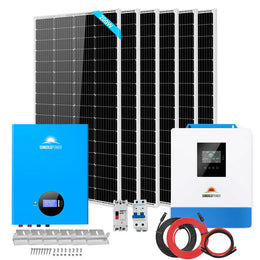
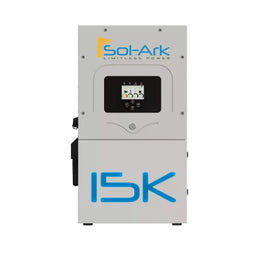
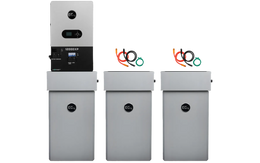
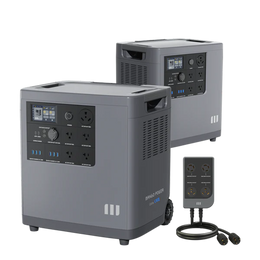
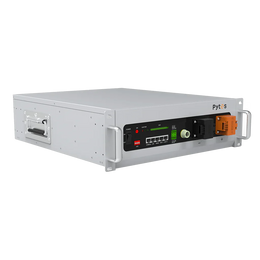
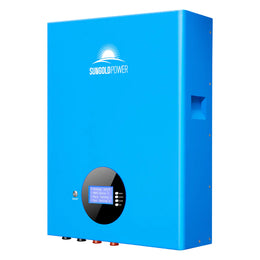


A portable power station and a home battery system store energy in the same LiFePO4 cells, so the real choice is not about chemistry. It is about how the power reaches your appliances, how much of the house you want running, how long the outage lasts and who does the wiring. A portable station is a battery, inverter and outlets in one box on wheels: you plug appliances into it. A home battery system is a wall- or floor-mounted battery bank paired with a hybrid inverter that an electrician connects to your main or backup panel, so circuits switch over automatically when the grid fails. Between the two sits a growing middle ground: portable stations that link to a home panel kit. This guide compares all three with live prices and stock from our store, shows the cost per kWh, does the runtime math for three household loads, and picks the best in-stock option on each side.
If you already know you want a fixed system, our whole-home battery backup cost guide goes deeper on pricing. If you lean portable, what size solar generator do I need covers watts and surge sizing.
Portable power station vs home battery at a glance
Here is the short version, based on the products we stock today. "Portable" means a power station you can roll and plug into; "home battery" means a battery bank plus hybrid inverter installed and wired to the panel.
| Factor | Portable power station | Installed home battery system |
|---|---|---|
| Typical size | 1-7 kWh per unit; 7-21 kWh with expansion packs | 14-30 kWh and up; expands to 50-200+ kWh |
| Output | 3,000-3,600W at 120V per unit; 6,000-12,000W at 240V with two linked units | 6,000-12,000W at 120/240V split phase from one inverter |
| How it powers the house | Extension cords, or a transfer switch / panel kit installed by an electrician | Wired into the main or a backup sub-panel; switches over in 10-20 ms |
| Installation | None for plug-in use | Licensed electrician, permit and inspection in most areas |
| Solar | 1,000-3,200W input per unit, portable or roof panels | 8,000-21,000W of roof or ground panels on the inverter |
| Moves with you | Yes: camping, RV, job site, next home | No: stays with the house |
| Price per kWh (our picks) | $347-$807 | $318-$508 before installation |
| Best for | Renters, short outages, essentials, mobile use | Owners, long outages, 240V loads, daily solar use |
The surprise in that table is price: a whole system like the NEXUS 14.3 kWh + EG4 6000XP costs less per kWh than most portable kits. You pay for portability with a higher price per kWh and less output; you pay for an installed system with labor, permits and the loss of mobility.
How the two systems actually differ
1. Where the inverter lives
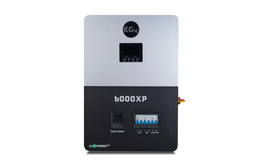
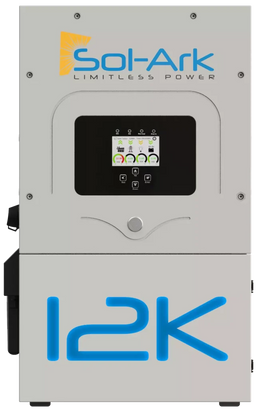
In a portable station, the inverter is built into the box and sized for 120V outlets: 3,600W on the Jackery HomePower 3600 Plus, 3,000W on each Mango Power E. To get 240V you link two units. In a home battery system, a separate hybrid inverter such as the EG4 6000XP or the 12 kW inverter in the EG4 PowerPro system makes split-phase 120/240V power, charges the battery from solar and the grid, and passes grid power through to the house (up to 200 A on the PowerPro).
2. How the switchover happens
A plug-in station has no idea the grid went down: you carry cords to the fridge. A home battery sits between the grid and your panel and switches in milliseconds (10 ms on the PowerPro, under 15 ms on the 6000XP), so the lights barely blink and nobody has to walk to the garage at 2 a.m. Panel kits for portable stations, like Mango's mPanel Pro or Anker's Home Power Panel, add that automatic switchover to stations you can still unplug and take away.
3. How much of the house runs
Cords reach a few appliances. A transfer switch or panel kit covers a set of chosen circuits (10 circuits on Anker's sub panel). An installed system with a 12 kW inverter can carry most of a typical panel, limited mainly by battery kWh and the inverter's battery-only rating (10,200W on the PowerPro, 6,000W on the 6000XP).
4. Where it can sit
Portable stations are indoor equipment rated for living spaces; the Jackery runs at about 30 dB, quiet enough for a bedroom. Installed batteries follow energy storage codes. The PowerPro is IP65 and NEMA 4X, so it can go outdoors; the NEXUS battery and 6000XP are indoor-only (garage or utility room). Codes based on NFPA 855 cap individual units and total kWh per room, and your inspector has the final word.

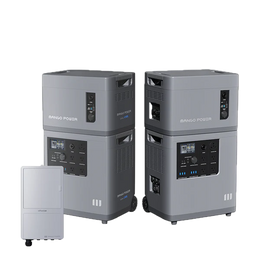
The middle ground: two portable stations feeding a home backup panel (shown: Anker SOLIX F3800 Plus with Home Power Panel, one of the picks below).
Cost: hardware price per kWh and what installation adds

Hardware price per kWh at list price, Nov 19, 2026. Installation, permits and solar panels not included.
| System | Type | Storage | Output | Price | Per kWh |
|---|---|---|---|---|---|
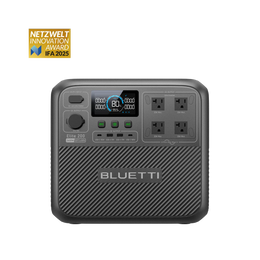
| Jackery HomePower 3600 Plus Red Cross | Portable, plug-in | 3.58 kWh (to 21 kWh) | 3,600W 120V (7,200W 240V with 2) | $1,609 | $449 |
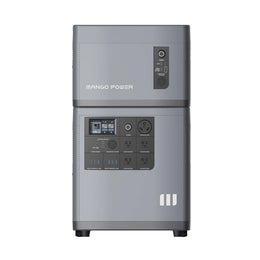
| Mango Power E 7 kWh 240V kit | Portable, 240V via mSocket Pro | 7.06 kWh | 6,000W 120/240V | $2,999 | $425 |
| Mango Power E 14 kWh kit + mPanel Pro | Portable + panel kit | 14.12 kWh | 6,000W 120/240V | $4,899 | $347 |
| Anker F3800 Plus x2 + Home Power Panel | Portable + panel kit | 7.68 kWh (to 53.8 kWh) | 12,000W 120/240V | $6,199.99 | $807 |
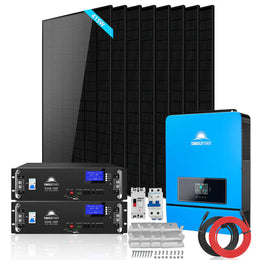
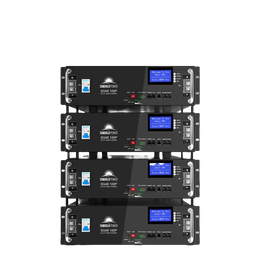
| NEXUS 14.3 kWh + EG4 6000XP | Installed, indoor | 14.3 kWh (to 214.5 kWh) | 6,000W 120/240V | $4,544 | $318 |
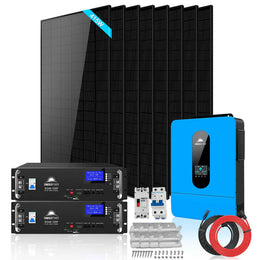
| EG4 PowerPro 12kW 14.3 kWh | Installed, outdoor-rated | 14.34 kWh | 12,000W (10,200W battery-only) | $7,289 | $508 |
What installation adds. A plug-in station adds nothing. Connecting a station to the house through a manual transfer switch or interlock and inlet box, or installing a panel kit, is electrician work. A full battery-plus-inverter install adds a permit, a sub-panel or main-panel rework, conduit, and an inspection. Labor varies a lot by region and panel layout, so get two local quotes before you compare totals. If you are adding storage to an existing solar array, read how to add a battery to an existing solar system first, because AC vs DC coupling changes the hardware list.
Promo codes today. On Nov 19, 2026, ECO100 ($100 off orders of $1,500 or more) applies to the Jackery HomePower 3600 Plus, both Mango Power E kits and the EG4 PowerPro system; SAVE250 ($250 off $4,000 or more) applies to the Anker F3800 Plus kit. Codes do not stack. The NEXUS + 6000XP bundle has no code. The federal 25D residential clean energy credit ended for expenditures after Dec 31, 2025, so a 2026 battery purchase does not qualify for it; check your state and utility for battery programs.
Sizing math: how many days each option lasts
Watts tell you what can run at the same time. Kilowatt-hours tell you for how long. Most outage decisions come down to kWh, so start with daily energy use:
- Essentials, about 3 kWh/day: refrigerator (1.2-1.8 kWh), internet router (0.25 kWh), LED lights for the evening (0.4 kWh), phone and laptop charging (0.2 kWh), a CPAP overnight (0.3 kWh), TV for a few hours (0.4 kWh).
- Essentials plus, about 8 kWh/day: add a furnace blower or a well pump, a microwave, and a chest freezer.
- Average US home, about 29 kWh/day: EIA's average of roughly 860 kWh a month, including central AC or electric heat in season.
Days of backup = usable kWh / daily kWh. Taking 90% of nameplate as usable after inverter losses: a 3.58 kWh Jackery gives 3.2 kWh, or about 1.1 days of essentials. The Mango 7 kWh kit gives 6.4 kWh, about 2 days. A 14 kWh class system (Mango E 14 kWh kit or NEXUS 14.3 kWh) gives about 12.8 kWh: 4.3 days of essentials or 1.6 days at 8 kWh. Two 14.3 kWh batteries on one inverter give 25.7 kWh: still less than one day for an average whole home with AC running.

Days of backup with no sun and no grid. Solar input extends every bar.
Solar changes the math. On a clear winter day, 1 kW of panels makes roughly 3-4 kWh in most of the US. The Jackery takes 1,000W of solar, each Mango Power E 2,000W, each Anker F3800 Plus 3,200W, the 6000XP 8,000W and the PowerPro inverter 18,000W. That is the biggest practical gap between the two sides: a home battery's inverter can usually be refilled every day from a full roof array, while a portable station is limited to a few portable or ground panels. For runtime of specific battery sizes, see how long a 5, 10 or 15 kWh battery runs a house.
Watts check. Add up what runs together, then size for the biggest motor start. A refrigerator draws 150-200W running but 600-1,200W for a second at start. A 1/2 hp 240V well pump can surge to 3,000-4,000W, which rules out a single 120V station. A 3-ton central AC needs 240V and a soft starter in most cases.
Connecting to the house: cords, transfer switch or panel
How a battery connects to the house decides comfort, cost and safety more than any spec sheet:
| Method | Works with | What runs | Install | Switchover |
|---|---|---|---|---|
| Extension cords | Any portable station | Plug-in appliances only (no furnace, well pump, hardwired lights) | None | Manual |
| Manual transfer switch or interlock + inlet box | Stations with a 30 A (TT-30 / L14-30) outlet | 6-10 chosen circuits, 120V or 240V | Electrician | Manual, a few minutes |
| Panel kit for portable stations | Mango mPanel Pro, Anker Home Power Panel | Selected circuits at 120/240V | Electrician | Automatic |
| Hybrid inverter + installed battery | NEXUS + 6000XP, EG4 PowerPro | A backup sub-panel or the whole panel | Electrician, permit, inspection | Automatic, 10-15 ms |
The best in-stock picks on each side
Prices and stock checked on November 19, 2026. All six are in stock and ship free within the contiguous US (no Hawaii or Alaska).
Mango Power E 14 kWh 240V Kit with mPanel Pro

Two Mango Power E stations (3.53 kWh, 3,000W each) and two 3.53 kWh expansion batteries give 14.12 kWh and 6,000W of 120/240V split-phase output. The included mPanel Pro is installed by an electrician at your panel and switches selected circuits over automatically when the grid fails. Unplug the stations and the expansion packs travel to a cabin or job site. CATL LFP cells are rated for 6,000 cycles to 70%, and each station charges 80% in an hour from the wall or takes 2,000W of solar.
$4,899 (list $5,599). ECO100 takes it to $4,799.
See price and stockJackery HomePower 3600 Plus Red Cross Edition

The simplest backup in this guide: 3,584 Wh, 3,600W continuous (7,200W surge), four 20 A outlets and a TT-30 30 A outlet, wheels and a 30 dB fan. Storm Alert Mode tops the battery up when the Jackery app sees severe weather. Add Battery Pack 3600 Plus units to grow to 21 kWh, or link a second unit with the Jackery Connector for 7,200W at 240V. It charges from the wall in about 2.5 hours and takes up to 1,000W of solar.
$1,609 (list $1,770). ECO100 takes it to $1,509.
See price and stockMango Power E 7 kWh 240V Kit with mSocket Pro

Two Mango Power E stations combined through the mSocket Pro make a portable 120/240V receptacle for a well pump, dryer or heavy tools, with 7.06 kWh and 6,000W. It does not wire into your panel on its own; pair it with a 240V transfer switch or move up to the mPanel Pro kit above for automatic switchover. Each station takes 2,000W of solar (60-150V).
$2,999 (list $3,149). ECO100 takes it to $2,899.
See price and stockAnker SOLIX F3800 Plus x2 with Home Power Panel

Two F3800 Plus stations (3,840 Wh each) and the Home Power Panel with a 10-circuit sub panel deliver 12,000W at 120/240V, enough for central AC or several 240V loads at once. Each unit takes 3,200W of solar and accepts a 240V generator at up to 6,000W. Capacity grows to 53.8 kWh with BP3800 batteries. The trade-off is price per kWh: storage is only 7.68 kWh for the money.
$6,199.99 (list $7,299). SAVE250 takes it to $5,949.99.
See price and stockNEXUS 14.3 kWh Battery + EG4 6000XP Inverter

The lowest price per kWh in this guide ($318). One BigBattery NEXUS 14.3 kWh LiFePO4 battery (7.6 kW continuous, 6,000+ cycles, 12-year warranty) pairs with the EG4 6000XP hybrid inverter: 6,000W of 120/240V split-phase output, 12,000W surge for 3.5 seconds, 8,000W of solar across two MPPTs and a sub-15 ms transfer. Both parts are indoor-rated, so plan for a garage or utility room. It scales to 15 batteries (214.5 kWh) and more inverters for 12-18 kW.
$4,544 (list $4,999). No code applies.
See price and stockEG4 PowerPro 12kW 14.3 kWh System

A 14.34 kWh PowerPro battery and a 12 kW hybrid inverter with an outdoor-rated, IP65 / NEMA 4X build, so it can hang on an exterior wall. Output is 12,000W at 240V with PV and grid, 10,200W from the battery alone, with 200 A grid pass-through, 10 ms transfer and 18,000W of solar input across three MPPTs. The battery is rated 8,000 cycles at 80% depth of discharge and has a self-heater and a built-in fire suppression unit; the system carries UL 9540.
$7,289 (list $8,299). ECO100 takes it to $7,189.
See price and stockWhich one should you buy?
- You rent, or move often: a portable station. Start with the Jackery HomePower 3600 Plus and add a battery pack later.
- Outages are short (hours to a day) and you only need essentials: a 3.5-7 kWh portable station with cords, or a manual transfer switch so the furnace fan and a few circuits run too.
- You need 240V (well pump, dryer, mini-split) but want to keep it portable: the Mango Power E 7 kWh 240V kit, or the 14 kWh kit with mPanel Pro for automatic switchover.
- Outages last days, or you want the whole panel covered: an installed home battery. The NEXUS + 6000XP for indoor installs on a budget, the EG4 PowerPro system for outdoor walls and 12 kW loads.
- You plan rooftop solar for daily savings: an installed hybrid system. Portable stations cannot use a full roof array.
- Still unsure: compare more complete systems in our home backup batteries, whole-home solar generators, Mango Power stations and EG4 solar kits collections, or read our best whole-house solar generators picks.
If the alternative you are weighing is a gas generator rather than a battery, our solar generator vs gas generator comparison covers fuel, noise and running cost.
What buyers ask before choosing
These questions come from searches that bring people to our site and from Google's related-question results for this topic. Answers use the specs of the products above.
Can I start portable and switch to a home battery later?
Yes, and it is a common path. Buy a station with a 30 A or 240V outlet now, have a transfer switch or panel kit installed later, and keep the station for camping once you move to a fixed system. Mango Power E and Anker F3800 Plus owners can add the panel kit without replacing the stations.
Is a home battery worth it without solar?
It can be if outages are frequent or long, if a well pump or medical device must stay on, or if your utility has time-of-use rates and lets the battery shift grid energy. Without any of those, a portable station gives most of the outage protection for less money.
Will a portable power station run my furnace?
A gas furnace blower needs about 300-800W, but it is hardwired, so a station can only run it through a transfer switch, interlock or panel kit. Electric resistance heat (10-20 kW) is beyond any portable setup and most single home batteries.
How loud are they?
Both are near silent compared with a generator. The Jackery runs at about 30 dB; Mango Power E is under 40 dB idle and about 51 dB at full load; the PowerPro system lists 68 dB at 3 ft (its inverter fans), which is one reason it often goes outdoors.
FAQ
Is a portable power station or a home battery better for power outages?
For outages of a few hours to a day where you only need the fridge, lights, internet and a CPAP, a 3-7 kWh portable power station is the better value because it needs no installation. For multi-day outages, 240V loads like a well pump or central AC, or daily solar self-use, an installed 14 kWh or larger home battery with a hybrid inverter is the better fit.
Can a portable power station power a whole house?
Only partly. A single 3,600W station covers essentials on 120V circuits. Two linked stations with a 240V panel kit, such as the Mango Power E 14 kWh kit with mPanel Pro or two Anker F3800 Plus units with the Home Power Panel, can run selected 120V and 240V circuits up to 6,000-12,000W, but an average US home uses about 29 kWh a day, so storage, not watts, sets the limit.
How much does a home battery cost compared with a power station?
At Eco Solar Kits on Nov 19, 2026, portable kits cost about $347-$807 per kWh of storage and installed battery-plus-inverter systems about $318-$508 per kWh before installation. Plug-in stations need no installer; installed systems and panel-connected kits need a licensed electrician and usually a permit, which adds to the total.
Do I need solar panels for a home battery?
No. A home battery can charge from the grid and hold the energy for outages, and some homeowners add solar later. Solar matters for outages longer than the battery lasts and for daily savings on time-of-use rates. Most hybrid inverters and portable stations have solar inputs built in.
Can I plug a portable power station into a wall outlet to power the house?
No. Never backfeed a house through a wall outlet with a double-male cord. It can energize utility lines, injure line workers and start fires. Use extension cords to appliances, or have an electrician install a transfer switch, interlock with an inlet box, or a dedicated backup panel.
Which lasts longer, a power station or a home battery?
Both use LiFePO4 cells. The picks here are rated 6,000-8,000 cycles, and warranties run 3+2 years (Jackery HomePower 3600 Plus), 5 years (Mango Power E, Anker F3800 Plus) and 12 years on the NEXUS battery.

Serhii Dovzhenko, Solar & Energy Storage Specialist at Eco Solar Kits · LinkedIn
Serhii is based in Vancouver, BC, and works on product data, system sizing and buyer guides for Eco Solar Kits. He attends solar and energy storage industry conferences and is involved in the community of electricians in Vancouver, BC. Credit for the data verification in this guide goes to Adsec.ca.


