

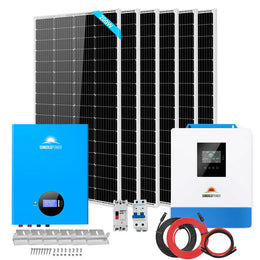
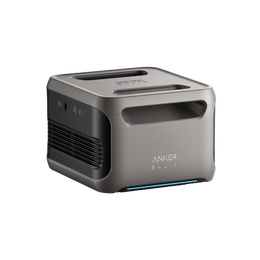

A power outage is the moment you find out whether your backup plan was sized correctly. We sell home backup systems every week, and the same three mistakes come up again and again: buying on wattage instead of battery capacity, forgetting that a well pump needs 240V, and not planning how the unit will be recharged on day two. This guide compares seven solar generators we currently stock, using the specs on our product pages, real runtime math and prices checked on October 19, 2026.
Best solar generators for home backup: comparison table
| Model | Battery | AC output | Voltage | Max expansion | Solar input | Weight | Price | Best for |
|---|---|---|---|---|---|---|---|---|
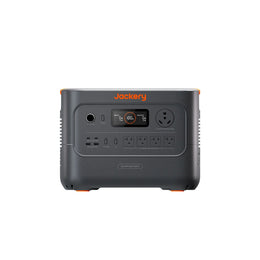
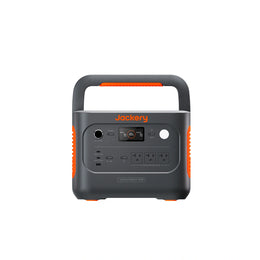
| Jackery HomePower 3600 Pro Max (sold out) | 3,584 Wh | 4,000 W (240V) / 2,000 W (120V) | 120/240V | 21.5 kWh | - | 73.9 lb | $1,799 | Whole-home circuits, 240V loads |
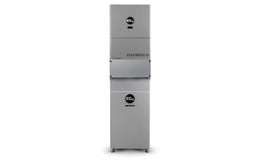
| Mango Power E 240V kit (2 units + mSocket Pro) | 7,060 Wh | 6,000 W | 120/240V | - | 4,000 W | 2 x 100 lb | $2,599 | Longest runtime from one unit |
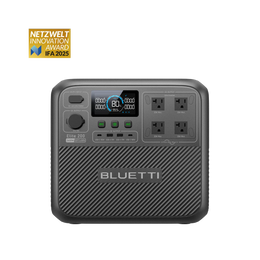
| Bluetti Apex 300 | 2,764.8 Wh LFP | 3,840 W | 120V or 240V (switch) | 58 kWh (up to 20 B300K) | 2,400 W | ~84 lb | $1,699 | Cheapest 240V-capable start |
| Mango Power E | 3,530 Wh | 3,000 W | 120V | 7.06 kWh | 2,000 W | 100 lb | $1,299 | Best value per kWh (120V) |
| Anker SOLIX F3000 (sold out) | 3,072 Wh LFP | 3,600 W | 120V | 24 kWh | 2,400 W | 91.5 lb | $1,499.99 | Fast solar recharge, 120V homes |
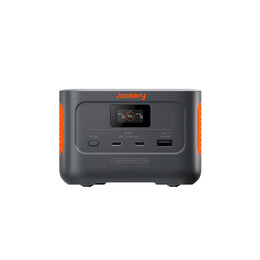
| Jackery Explorer 2000 v2 | 2,042 Wh | 2,200 W | 120V | - | - | 39.5 lb | $999 | Essentials on a budget |
| Bluetti Elite 200 V2 | 2,073.6 Wh LFP | 2,600 W | 120V | 5.1 kWh | 1,000 W | 53.4 lb | $899 | Lightest 2 kWh option |
Prices are Eco Solar Kits prices on October 19, 2026, before promo codes. All seven use LiFePO4 (LFP) batteries, the safest and longest-lasting chemistry for home storage. Free shipping to the lower 48 states.
How many hours will each one run your essentials?
We modeled a typical "keep the house functional" outage load: a refrigerator, Wi-Fi router and modem, LED lighting, a TV for a few hours and phone and laptop charging. That adds up to about 2.6 kWh per day. We then assumed 85% of the rated battery is usable after inverter losses, which matches independent measurements of current LFP power stations.
The takeaway: a 2 kWh unit covers an overnight outage. For a 2-3 day storm outage without solar, you need 5 kWh or more, or a smaller unit plus panels to refill it every day.
Price per kWh: what you actually pay for storage
Inverter wattage gets the headlines, but battery capacity is what keeps the lights on. Dividing price by capacity is the fastest way to compare value.
The cheapest storage per kWh is in the 2-3.6 kWh, 120V class. You pay a premium of roughly $150-200 per kWh for 240V output and higher-wattage inverters (HomePower 3600 Pro Max, the Mango Power E 240V kit, Apex 300). That premium is worth it only if you actually have 240V loads.
How to choose: 5 questions before you buy
1. Essentials or whole-home?
Essentials backup (fridge, internet, lights, medical devices) needs 2-4 kWh and a 120V unit. Whole-home backup that includes a well pump, central air or an electric range needs 240V output, 6,000 W or more, and 10 kWh+ of expandable storage.
2. Do you have 240V appliances?
Most US well pumps, many sump pumps over 1 HP, central AC, electric dryers and ranges run on 240V. A 120V-only power station cannot start them. Of the seven picks, the HomePower 3600 Pro Max, the Mango Power E 240V kit and Apex 300 support 240V.
3. What will start, not just what will run?
Motors draw 3-5 times their running watts for a split second when they start. A 1 HP well pump that runs at about 1,200 W can need 3,500-4,500 W to start. Check the starting watts in the table below against the unit's AC output.
| Appliance | Running watts | Starting watts | Energy per day |
|---|---|---|---|
| Refrigerator (18-22 cu ft, Energy Star) | 100-200 W | 600-1,200 W | 1.2-1.8 kWh |
| Chest freezer | 50-100 W | 400-800 W | 0.6-1.0 kWh |
| Wi-Fi router + modem | 15-25 W | - | 0.4-0.6 kWh |
| CPAP (no heated humidifier) | 30-60 W | - | 0.3-0.5 kWh per night |
| 10 LED bulbs, 5 hours | 90 W | - | 0.45 kWh |
| Sump pump, 1/2 HP | 800-1,050 W | 2,000-2,200 W | Depends on cycles |
| Well pump, 1 HP (240V) | 1,000-1,500 W | 3,500-4,500 W | 1-3 kWh |
| Window AC, 8,000 BTU | 600-800 W | 1,200-1,800 W | 3-6 kWh |
| Central AC, 3-ton (240V) | 3,000-4,000 W | 9,000+ W (soft starter advised) | 15-30 kWh |
Typical ranges. Check your appliance nameplate for exact figures.
4. How will you recharge on day two?
Solar is what turns a battery into a multi-day backup system. A rough rule: daily solar harvest ≈ panel watts × peak sun hours × 0.8. For example, 800 W of panels × 5 sun hours × 0.8 ≈ 3.2 kWh per day, enough to refill a 3.5 kWh unit on a clear day. Units with higher solar input (the Mango Power E 240V kit at 4,000 W across its two units, a single Mango Power E at 2,000 W) can use bigger arrays and recharge faster.
5. How will it connect to your house?
For essentials, you can plug appliances straight into the unit. To power hardwired circuits, you need a transfer switch, a home power panel or a power inlet with an interlock, installed by a licensed electrician. Never backfeed a home through a dryer outlet. Jackery's HomePower 3600 Pro Max connects to household circuits through a manual transfer switch, and the Mango Power E home kit with mPanel Pro includes Mango's mPanel Pro home panel.
The 7 best solar generators for home backup in 2026
1. Jackery HomePower 3600 Pro Max - best for whole-home backup (sold out)

One unit gives true 240V: 4,000 W at 240V (8,000 W surge) through a NEMA 14-50 outlet, or 2,000 W on its 120V outlets. 3,584 Wh of LiFePO4 rated for 6,000 cycles runs a fridge, lights, internet and a furnace blower through a long evening, and add-on battery packs take it to 21.5 kWh (43 kWh with two units in parallel). A sub-10 ms UPS keeps computers on through a grid drop, and it connects to household circuits through a manual transfer switch.
2. Mango Power E 240V kit (2 units + mSocket Pro) - most capacity for the money

Two Mango Power E units joined by the included mSocket Pro give 6,000 W of combined output on a 240V split-phase receptacle and 7,060 Wh of LiFePO4 storage - enough for a well pump or other 240V load plus the usual essentials. Each unit takes up to 2,000 W of solar (4,000 W total), the cells are rated for 6,000 cycles, and at $2,599 the kit works out to about $368 per kWh.
3. Bluetti Apex 300 - the cheapest way into 240V
2,764.8 Wh · 3,840 W · 120V or 240V via a selector · expandable to 58 kWh · 2,400 W solar · $1,699
The Apex 300 starts smaller but scales the furthest: up to 20 B300K expansion batteries for 58 kWh. It switches between 120V and 240V, and charges from AC at up to 3,840 W with a 30A or 50A cable, so it refills fast when grid or generator power is available. The listing rates it for 6,000 cycles with a 5-year warranty.
4. Mango Power E - most kWh per dollar

3,530 Wh of LiFePO4 (rated for 6,000 cycles) and 3,000 W of 120V output for $1,299 - about $368 per kWh, the lowest of any single power station we carry. It accepts up to 2,000 W of solar, adds a second battery for 7,060 Wh, and has a 5-year warranty. At about 100 lb it is a roll-it-around unit rather than a carry one.
5. Anker SOLIX F3000 - big solar input at a mid-range price (sold out)
3,072 Wh · 3,600 W · 120V · expandable to 24 kWh · 2,400 W solar (2 MPPT) · $1,499.99
The F3000 accepts up to 2,400 W of solar, more than double most 120V units, so it is the best 120V pick if you plan to run off solar for days. Note: its BP3000 expansion battery is out of stock until November 2026, so buy it now only if the base 3 kWh is enough to start.
6. Jackery Explorer 2000 v2 - essentials under $1,000

2,042 Wh of LiFePO4 and 2,200 W of output run a fridge, router, lights and phone charging through a night, or a CPAP for several nights. At 39.5 lb it is light enough to carry, and at $999 it is about $489 per kWh.
7. Bluetti Elite 200 V2 - easiest 2 kWh to move
2,073.6 Wh · 2,600 W · 120V · expandable to 5.1 kWh · $899
At 53.4 lb, the Elite 200 V2 is the lightest 2 kWh unit on this list, which matters if you also take it camping or store it upstairs. It has a 5-year warranty and Wi-Fi/Bluetooth app control.
What our customers ask before buying
- "Is it for a house, an apartment or a shed?" This is the first question our support team asks, because it decides voltage and size. A house with a well pump needs 240V; an apartment rarely does.
- Delivery and weight. Large units weigh 60-137 lb and ship by ground carrier, usually in 4-10 business days. Plan who will lift it and where it will live (a garage or utility room near the panel is ideal).
- Bundles with panels. Among our most-ordered home backup bundles this fall are the Jackery HomePower 3000 with 2x SolarSaga 200W ($2,149) and the Jackery Solar Generator 2000 v2 with 2x 200W panels (sold out) ($1,399). Buying the panels in a bundle usually costs less than adding them later.
Solar generator vs gas generator for home backup
| Solar generator (battery) | Gas or propane generator | |
|---|---|---|
| Indoor use | Yes, no fumes | No, carbon monoxide risk |
| Noise | Near silent | Loud (60-75 dB typical) |
| Fuel during long outages | Sun, refills daily with panels | Needs fuel supply |
| Upfront cost for 3-5 kWh | $1,400-3,200 | Lower for the same wattage |
| Maintenance | Almost none | Oil changes, fuel stabilizer, test runs |
| Instant switchover (UPS) | Yes on most models | Only with automatic standby units |
Many buyers end up with both: a battery for silent, instant backup and a small gas generator to recharge it during long cloudy outages. Any of the picks above can recharge from a generator AC outlet; check the manual for the maximum AC input.
Frequently asked questions
What size solar generator do I need for home backup?
For essentials (fridge, internet, lights, phone charging), plan on 2-4 kWh of battery and 2,500-3,600 W of output. For a well pump or other 240V loads, choose a 120/240V unit with 4,000 W or more, such as the Mango Power E 240V kit (6,000 W) or the Jackery HomePower 3600 Pro Max (4,000 W at 240V).
Can a solar generator run a whole house?
Yes, if it has 240V split-phase output, enough capacity and a proper connection to your panel. Expect 10-20 kWh of expandable storage, a transfer switch or home power panel, and a solar array to recharge daily. Central AC and electric heat are usually the loads people choose to leave off.
How long will a solar generator run a refrigerator?
A modern fridge uses about 1.2-1.8 kWh per day. A 2 kWh unit runs it alone for roughly 1 day, a 3.6 kWh unit for about 2 days and a 5 kWh unit for about 3 days, before solar recharging.
Do I need 240V output?
Only if you need to run 240V appliances during an outage: well pumps, central AC, electric dryers, ranges or some large sump pumps. If your must-run list is the fridge, internet, lights and medical devices, 120V is enough and costs less per kWh.
How many solar panels do I need to recharge a solar generator?
Multiply panel watts by your peak sun hours and by 0.8 for losses. 800 W of panels in 5 sun hours produces about 3.2 kWh per day, which refills a 3-3.5 kWh battery on a sunny day.
Is there still a federal tax credit for solar generators?
The 30% Residential Clean Energy Credit (25D) does not apply to expenditures made after December 31, 2025. Some states and utilities still offer battery storage incentives, so check locally.