Solar Power for Camper Van Builds: Station, Kit or Full 48V System
Solar power for camper van living has to fit in a space the size of a closet, weigh as little as possible and still run a fridge, laptops, a fan and, for some, an induction cooktop. There are three ways to get there: a portable power station that needs no wiring, a battery-plus-inverter kit that you mount and wire yourself, or a complete camper van solar system with panels, inverter and battery already matched.
This collection holds 199 products from Bluetti, Anker, BigBattery and Sungold Power. Prices start at $899 for the Bluetti Elite 200 V2 station and run to $15,725 for a 16,000W Sungold Power system that belongs in a bus conversion, not a Sprinter.

How to choose a camper van solar system kit
-
Daily energy. A 12V fridge, LED lights, two laptops, a roof fan and phones come to 1,000 to 1,500Wh per day. Induction cooking adds 500 to 1,000Wh. Under 2,000Wh a day, the Bluetti Elite 200 V2 (2,600W, 2,073.6Wh) at 53.4 lb is the simplest answer: strap it down, plug in a panel, done.
-
Cooking and heat. Induction, a hair dryer or a small heater need 1,500 to 1,800W at once. The Elite 200 V2 lifts to 3,900W for resistive loads. For a permanent install, the HUSKY 2 5.12kWh Kit with Victron MultiPlus-II 3,000W gives 5,120Wh, a proper inverter/charger and a Cerbo GX display, and its PowerAssist mode adds battery power on top of a weak campground pedestal.
-
Air conditioning. A rooftop AC unit changes everything: 5,000Wh or more of battery and 6,000W of inverter. The Anker SOLIX F3800 + PS400 400W Panel delivers 6,000W and 3,840Wh with expansion to 26.9kWh, all without wiring into the van.
-
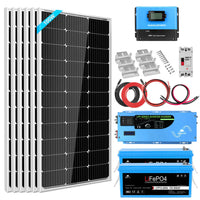
Roof space. A high-roof van holds 400 to 600W of rigid panels. That refills 1,500 to 2,500Wh on a sunny day, which is why most vans pair roof panels with alternator charging. The Sungold Power 5,000W Kit with 5.12kWh and 6 x 200W panels includes six 200W modules, more than a van roof takes, so it suits a van plus trailer or a base-camp setup.
Popular picks in this collection
| Product |
Key numbers |
Best for |
Price from |
| Bluetti Elite 200 V2 |
2,600W, 2,073.6Wh, 53.4 lb |
Weekend vans, no-wiring builds |
$899 |
| Anker SOLIX F3800 + 400W Panel |
6,000W, 3,840Wh, 2,400W solar input |
Vans with AC or induction cooking |
$2,600 |
| HUSKY 2 5.12kWh + Victron 3,000W |
5,120Wh, 3,000VA, Cerbo GX, 48V |
Full-time vanlife, fixed install |
$2,920 |
| Sungold Power 5,000W, 5.12kWh, 6 x 200W |
5,000W, 5.12kWh, 1,200W array |
Van plus trailer or base camp |
$3,145 |

Setup and usage tips
- Use the Solar Kit Calculator with your appliances and ZIP code. It sizes battery, inverter and panels together and tells you whether your roof can carry enough solar or whether alternator charging has to do the heavy lifting.
- Weigh the build. A 48V kit with a Victron inverter and 5.12kWh of battery adds real weight low in the van; check your payload rating after water tanks and cabinetry.
- Mount rigid panels with a gap underneath for airflow. Hot panels lose output, and a flat roof in July gets hot.
- Plan for shade days. Two cloudy days with a 400W roof array means your camper van solar power drops to a few hundred watt-hours; a 5,120Wh bank covers the gap, a 2,073.6Wh station may not.
Frequently asked questions
Do I need a permanent install or is a power station enough? If you camp weekends and can charge at home, a station like the Elite 200 V2 with one folding panel is enough. Full-time living, induction cooking or AC pushes you to a 48V kit or the F3800 class.
How much solar for camper van roofs is realistic? Most high-roof vans fit 400 to 600W once you leave room for a fan and a vent. Assume 1,500 to 2,500Wh per sunny day from that array.
Can I charge from the alternator too? Yes, and most full-timers do. A DC-to-DC charger between the alternator and a fixed 48V bank like the HUSKY 2 kit is the usual add-on, and it keeps the alternator within safe current. Check the charger's output voltage matches your bank before buying.
Everything ships free to the mainland US from brand partner warehouses, usually within a few business days, with 30-day returns. If you are between a station and a wired kit, call us and we will run the numbers on your van.